44
In the 1950s, Western Australian historian Henrietta Drake-Brockman was studying E. D. Drok’s translation of PeIsaert’s original account. Unlike the edited publication carried by Wickham and Stokes, Drok’s translation included Pelsaert’s description of wallabies as ‘cats’. This was significant as it was the first European description of a marsupial. Knowing that wallabies only lived in the Wallabi Group, and matching other features in Pelsaert’s journal such as the ‘high islands’ to East and West Wallabi Islands, Drake-Brockman proposed that the wreck site would accordingly be found in the
Wallabi Group. Her theory was first made public in an article published in 1955. However, it did not receive serious attention until 1960 when rock lobster fisher ‘Pop’ Marten discovered human skeletal remains and historical artefacts on Beacon Island. The finding of a finely engraved section of a trumpet—the bell garland—with the inscription: MACHT ICH CONRAT DROSCHEL M DCXXVIII [made by Conrat Droschel 1628] was the first piece of material evidence supporting Drake-Brockman’s theory that Batavia was indeed wrecked in the Wallabi Group.

Morning Reef
In June 1963, the Batavia wreck site was located on Morning Reef. The underwater site was first seen by rock lobster fisher Dave Johnson, who reported it to Geraldton local Max Cramer. Together with Graham Cramer and Greg Allen, the men were the first to dive on the site. Henrietta Drake-Brockman along with Hugh Edwards, who led the first expedition to the Batavia sites, and Bruce Melrose also played important parts in the discovery. In the same year, a salvage expedition recovered three bronze and one composite cannon, two astrolabes, coins and ceramic material.
The tammar wallaby (Macropus eugenii), inhabits three islands in the Houtman Abrolhos group.
Credit: WA Museum
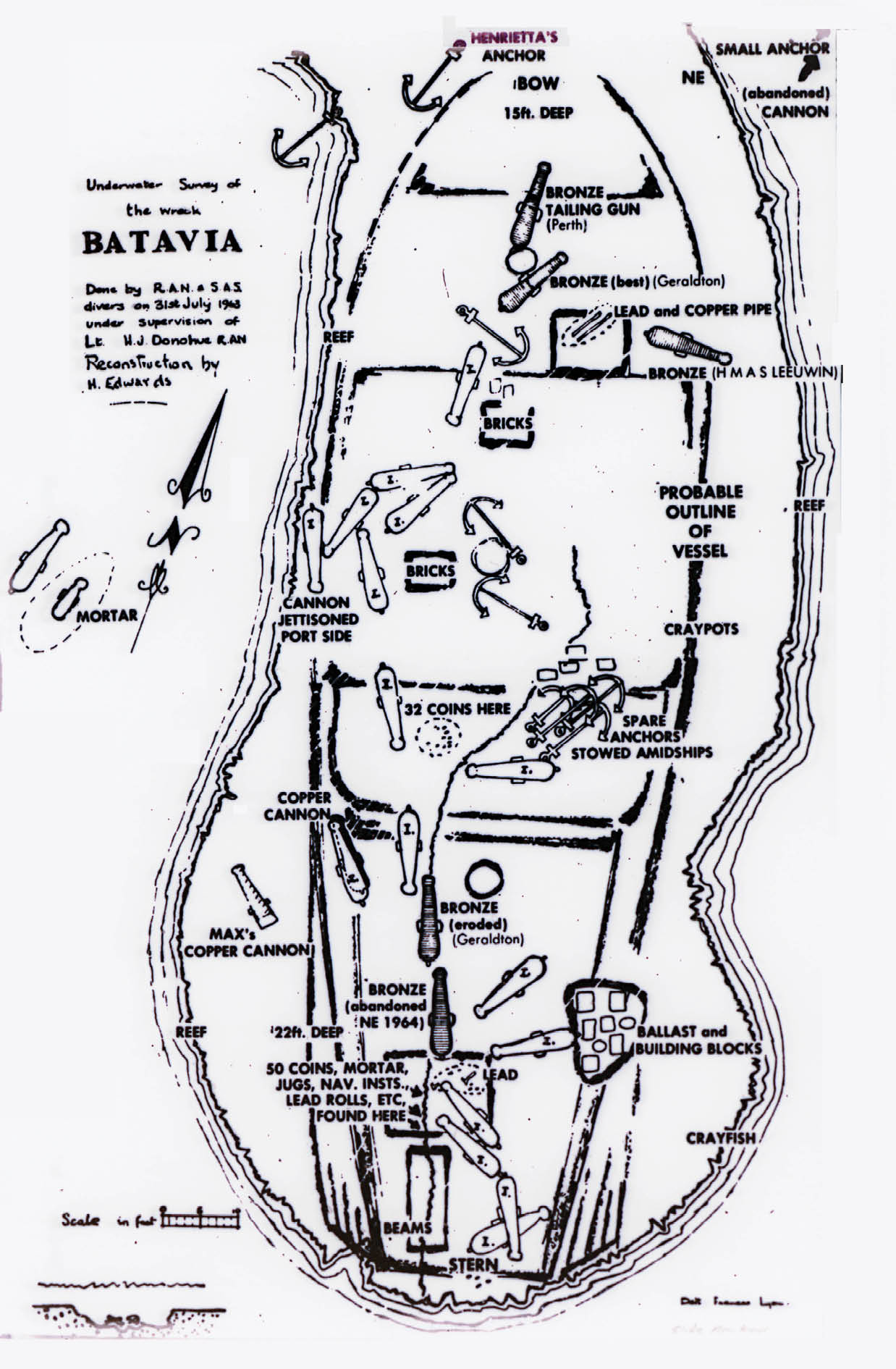
Royal Australian Navy survey of Batavia in 1963, drawn by Lieutenant H. Donohue.
Credit: H. Edwards

DISCOVERY


POLICE, WESTERN AUSTRALIA
Criminal Investigation Branch, Geraldton
6th April, 1960
Re: Skeleton found on Beacon Island in Wallabi Group of Abrolhos Islands
REPORT:
Inspector Sunter
I have to report that on the 25th. March, 1960, Maxwell David Roylance….reported to Geraldton Police that on 23-3-160 he had found a skeleton on Beacon Island which is in the Wallabi Group of the Abrolhos Islands.
Roylance stated that he had dug a hole on Beacon Island near the premises of a Fisherman named William Bevilaqua and in doing so had uncovered the upper part of a skeleton.
On 28-3-60, in company with Constable Scott, I went to Beacon Island.
Beacon Island is a coral island of about 1 1/2 acres in area is situated 50 miles north west of Geraldton.
The island has a population of about ten persons who are housed in four shacks. These people occupy the Island from March to August of each year and are occupied in Crayfishing, the Island is unoccupied for the remainder of the period August to March.
The grave containing the skeleton was situated about 8 feet from the south side of William Bevilaqua’s shack which is on the northern portion of the island.
Roylance had uncovered the upper part of the skeleton, as far as the waist, these bones were packed in a box and were at the scene.
The rest of the skeleton was then uncovered and removed from the grave.
The bones give the appearance of being very old and have started to decompose.
The skeleton was covered by about 16 to 18 inches of brown soil and was resting on coral.
The condition of the bones were such that each bone had to be removed separately from the grave.
The skeleton was buried face upwards, the feet were together, and according to Roylance, the arms across the chest.
All of the soil in and around the grave was sifted but nothing found was foreign to the Island.
Constable Scott and myself brought the bones back to Geraldton.
There is a distinct possibility that the skeleton could be the remains of the wife of a Captain Goss who is alleged to have buried his wife on Beacon Island many years ago.
I believe that a local writer, Henrietta Drake-Brockman, made inquiries concerning Captain Goss and the history surrounding this man. Perhaps she could assist with this inquiry.
This particular section of the Abrolhos Islands is also alleged to be the spot where the Dutch ship “Batavia” was wrecked in the June of the year 1629. History tells us that many of the shipwrecked persons were murdered shortly after the “Batavia” was wrecked, perhaps this skeleton belongs to one of those people.
The bones have been forwarded to the Criminal Investigation Branch, Perth, this date, per Detective Sergeant Lee who is returning to Perth after holidaying in the Geraldton area.
I respectfully request that this report be forwarded to C.I.B Perth.
Perhaps Doctor Pearson, District Medical Officer, and the Anthropology Department of the University of Western Australia could assist this inquiry.
C.I.B. Geraldton, Sgd. Det. Ayres
6-4-60 Detective 2319