60

Archaeology, artefacts and archives


Pelsaert’s Silver
Between 1605 and 1627, the fourth Mughal emperor Jahangir (Nur-ud-Din Muhammad Salim) ruled a large part of India, and was one of the richest and most powerful rulers in the world. Following Jahangir’s death, his son Shah Jahan (Shahab-ud-din Muhummad Khurram) ruled between 1628 and 1658—ushering in the peak of the Mughal empire’s glory, and building architectural treasures such as the Taj Mahal in Agra and the Red Fort in Delhi.
As Portugal, the Netherlands and England competed for the valuable India trade, they sought the Mughal emperors’ permission to access ports, and build trading posts or ‘factories’ to support their activities. The Mughal rulers had no interest in European goods such as cheese, timber and woollen cloth, preferring to trade only in silver and gold, or extravagant objects that took their fancy, such as jewels, artisanal wares, decorated weapons and exotic animals.
Presents and profits
The VOC sought to increase the sale of European commodities in Asian markets to reduce the flow of precious metals (bullion and coins) to the East. In his Remonstrantie, a 1627 commercial report to the VOC directors based on his seven years of experience as a VOC official in India, Pelsaert observed that ‘large profits could be made on the goods…brought by our ships from Holland’. He recommended that the Company should manufacture gold and silver ‘into articles which are here in common use’.
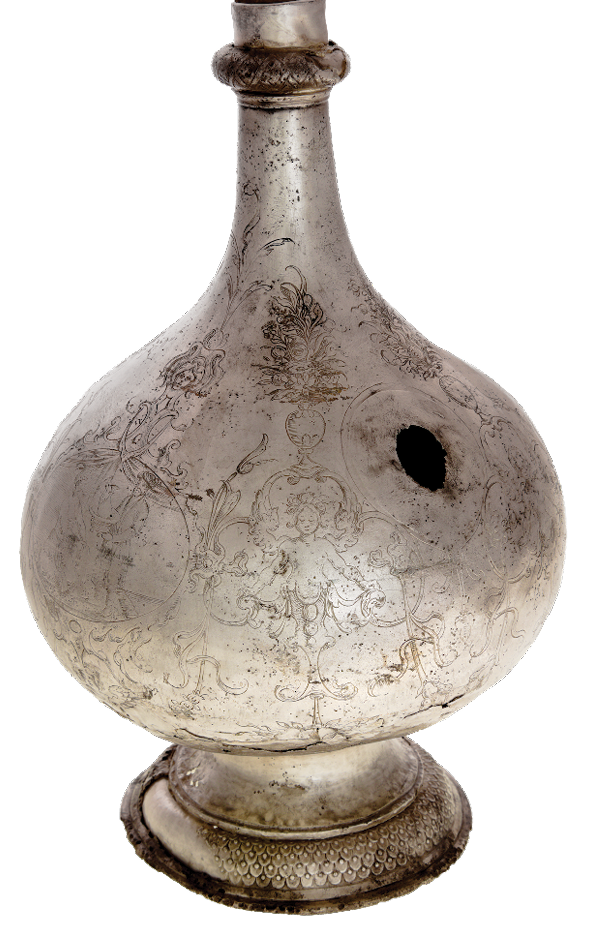
Pelsaert commissioned several pieces of trade silverware in the Netherlands to present to one of the most powerful men in the world. The finely crafted objects included a large plate, a jug (or ewer), and decorative bed posts. With the value of these artworks exceeding the value of their base metal content, Pelsaert hoped to both improve diplomatic relations, and create a profitable new trade in such luxury wares.
The pieces were decorated to appeal to the emperor. The favourite sports of the Mughals, such as hunting and fishing are depicted on a
plate. Engravings on the ewer show the Islamic ritual cleaning of a Mughal prince’s hands prior to eating or drinking. An identical ewer has also been engraved on the object itself. On another piece, an engraved motif shows a servant presenting his seated master with a covered bowl, while another depicts a servant carrying a basin and ewer as the princely Mughal figure sits, drying his hands on a towel. Similar depictions of reclining people in Moorish dress also decorate the bed-post knob.
Lost and found
When Pelsaert returned to the Abrolhos Islands in Sardam, his efforts to salvage these valuable goods from the wreck of Batavia were unsuccessful, and they remained preserved underwater until they were excavated by the WA Museum in the 1970s. As a rare collection of early seventeenth century Amsterdam silverware, these objects represent a unique insight into early diplomatic ties and trade exchange between the Netherlands and Mughal India.