Archaeology, artefacts and archives
63
Archaeology, artefacts and archives
Stone blocks on Morning Reef
When divers first visited the Batavia wreck site in 1963, they noticed many large sandstone blocks scattered over the reef. Some of these blocks had writing inscribed on the surface. During excavations from 1972-1976, 137 blocks were recovered, totalling 37 tonnes.
It is not uncommon to find heavy things like stone on shipwreck sites. They were often used as ballast, which weighs down the bottom of the ship to keep it steady. However, these stones were not just ballast, they were important cargo.
Reconstructing the portico
The writing on the blocks were mason’s marks, which provided instructions on how to assemble them into an enormous stone portico façade. Archaeologists attempted to put them together immediately after recovery, but they were far too heavy to move without equipment. The blocks were moved to a museum warehouse in Fremantle and partly reconstructed using a forklift.
A 1:10 scale model of each block was made, and it soon became clear that a full reconstruction was possible. Following the order of the mason’s marks (B2-B8), the column stones were stacked in alternating layers of half-drums. The pediment (the top of the arch) was unmarked and was reconstructed through trial and error. Six bronze pintles were also found on site, which would have been hinges for massive wooden doors. A small number of blocks were not included, and these were possibly intended to form small windows.
Final destination
The portico was originally intended to be built at the gates of Kasteel Batavia [castle]. A drawing by Pieter Van den Broeck shows a bird’s-eye view of the castle in Batavia under siege, with scaffolding for an unfinished gate. Vingboom’s Atlas shows the gate at a later date (probably 1630s-1640s), with a portico façade on the Waterpoort [water gate] of an identical design to that recovered from the Batavia wreck site.
The original portico is on display in the Museum of Geraldton and a replica portico is on display at the Shipwrecks Museum in Fremantle.
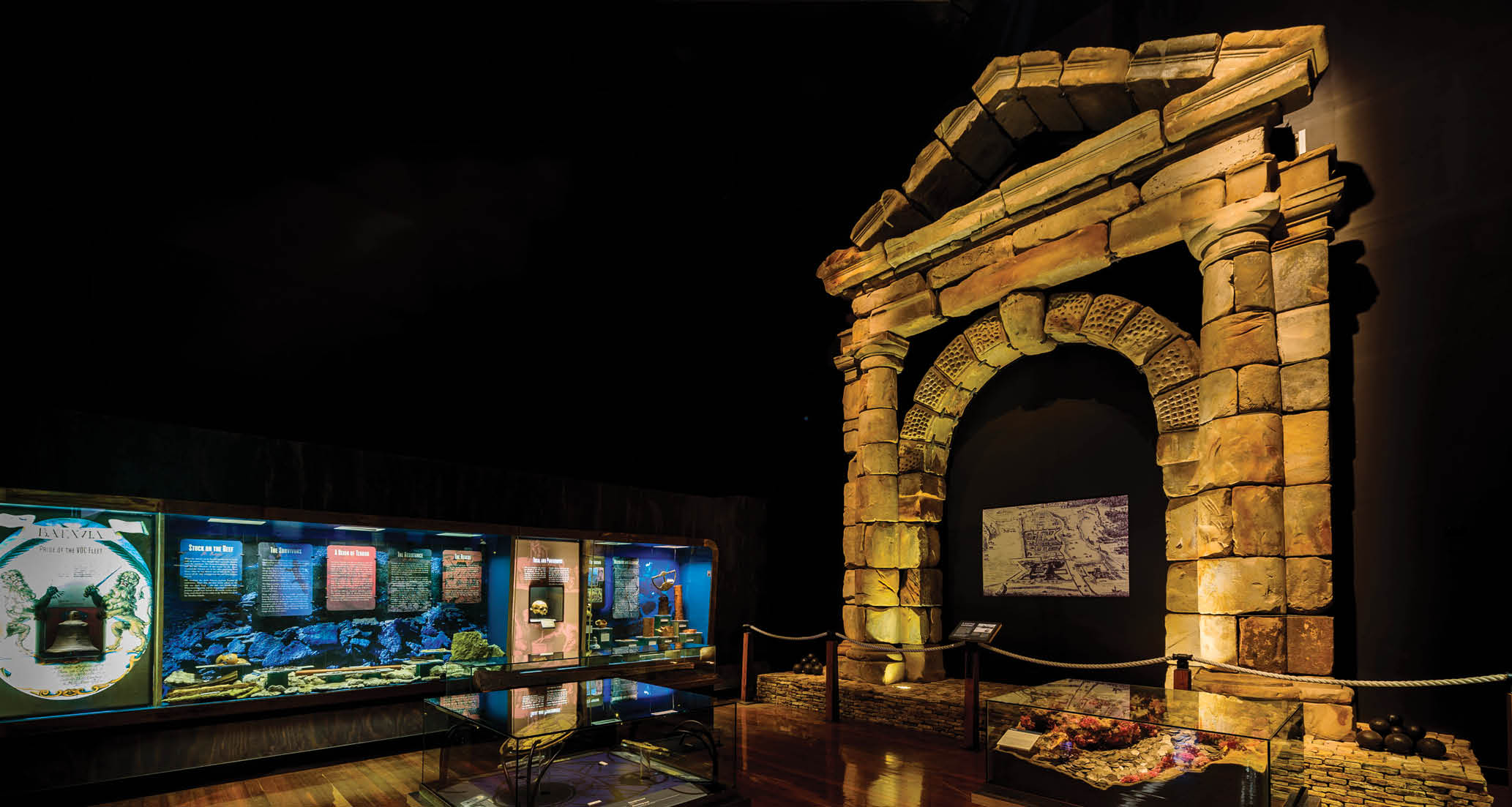


Top: The Batavia portico, reconstructed and on display in the Museum of Geraldton.
Credit: I. Brodie
Bottom left: Portico blocks at the Batavia wreck site, 1973.
Credit: WA Museum, BTA_0090
Bottom right: Recovery of the portico blocks on the Museum work boat, 1973.
Credit: WA Museum, BTB_305


Bird’s-eye view of the city of Batavia, attributed to Adriaen Matham (print), about 1632-1646.
The etching shows Kasteel Batavia and the scaffolding for the unfinished gate in the foreground.
Credit: Rijksmuseum, Amsterdam