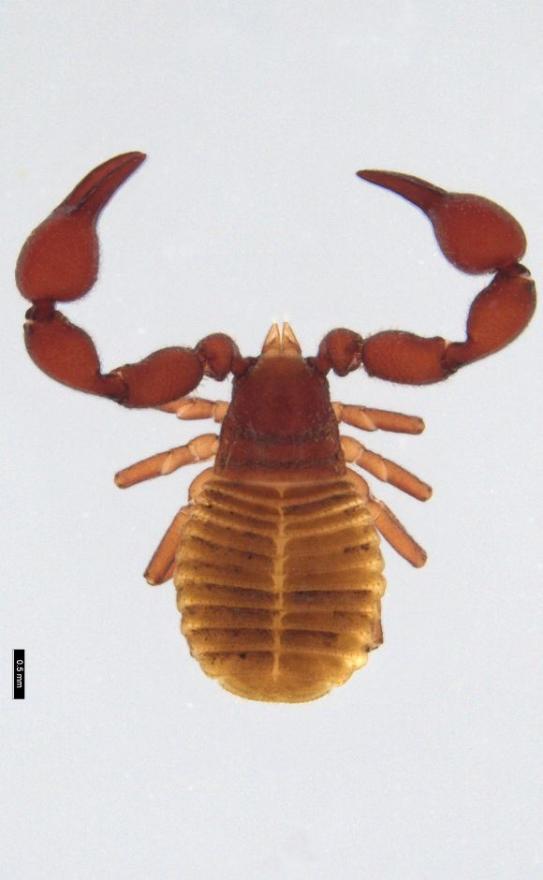
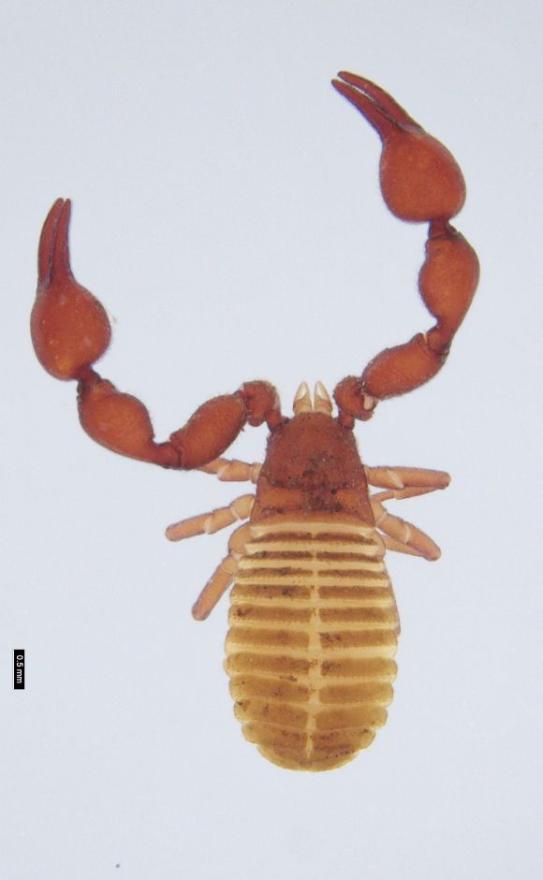
- Four new pseudoscorpions, including two in a new genus, have been discovered in Australia.
- These tiny species live only on threatened or vulnerable mammals.
- Their survival depends entirely on their host species, highlighting fragile ecological connections.
Australian scientists have uncovered a hidden world of tiny pseudoscorpions living on some of the nation’s most iconic and vulnerable mammals, highlighting their vital role in reducing parasites and maintaining ecosystem health.
These microscopic species have now been formally described by Western Australian Museum Research Associate Dr Mark Harvey and his colleagues who have identified four new species of pseudoscorpions, including two belonging to a completely new genus, showing how much of Australia’s biodiversity remains unexplored.
Two of the newly described species belong to the genus Austrochernes. Austrochernes intutus was discovered in the nests and fur of the critically endangered Leadbeater’s possum in Victoria, while Austrochernes pauculus was found in the nest of the threatened wambenger (Phascogale tapoatafa wambenger) in southern Western Australia.
The study also introduces a completely new genus, Enigmachernes, with two species found exclusively on bats in eastern Australia. Enigmachernes parnabyi lives solely on the vulnerable eastern false pipistrelle, and Enigmachernes dissidens is found on the southern forest bat, which is not currently considered threatened.
“None of the four species have been recorded anywhere else in the world and live exclusively on threatened or vulnerable mammals. If those mammals decline, these pseudoscorpions could disappear too, highlighting the fragile connections in Australia’s ecosystems,” Dr Harvey said.
At only 3–4 millimetres long, these nearly invisible creatures use venom-tipped pincers to capture mites, fleas, and lice in their hosts’ fur and nests, playing a subtle but important ecological role.
“These findings have global significance. By reducing parasite loads, pseudoscorpions help support the health of mammals already under environmental pressure.
“The introduction of an entirely new genus also provides rare insight into evolutionary pathways and emphasis how much of the natural world is still undocumented.”
Australia is estimated to be home to more than 600,000 species of plants, animals, fungi, and other organisms, yet only around 30% have been formally named.
“Discoveries like these remind us that we are still only scratching the surface of Australia’s biodiversity and why understanding and protecting these ecosystems is so urgent,” Dr Harvey said.
For more information on the research, visit the Australian Journal of Zoology, A new genus of Australian pseudoscorpions and New pseudoscorpions of the genus Austrochernes.