FameLab Australia 2026 National Final
Doors open | 5.30pm
Standard | $20
Concession | $17
Junior ( Ages 12-17) | $15
Membership
Friend Members receive 15% off ticket pricing for this event.
Site access information
WA Museum Boola Bardip is fully accessible. Call 1300 134 081 for assistance. Accessible resources and programs >
Watch 13 of Australia’s brightest early-career researchers compete for the title of FameLab Australia 2026 Champion.
The challenge: No slides. No PowerPoint. No jargon. No boring.
Each finalist has three minutes to explain their research in clear, engaging language that anyone can understand. They will be judged on the three Cs of FameLab: Content, Clarity and Charisma.
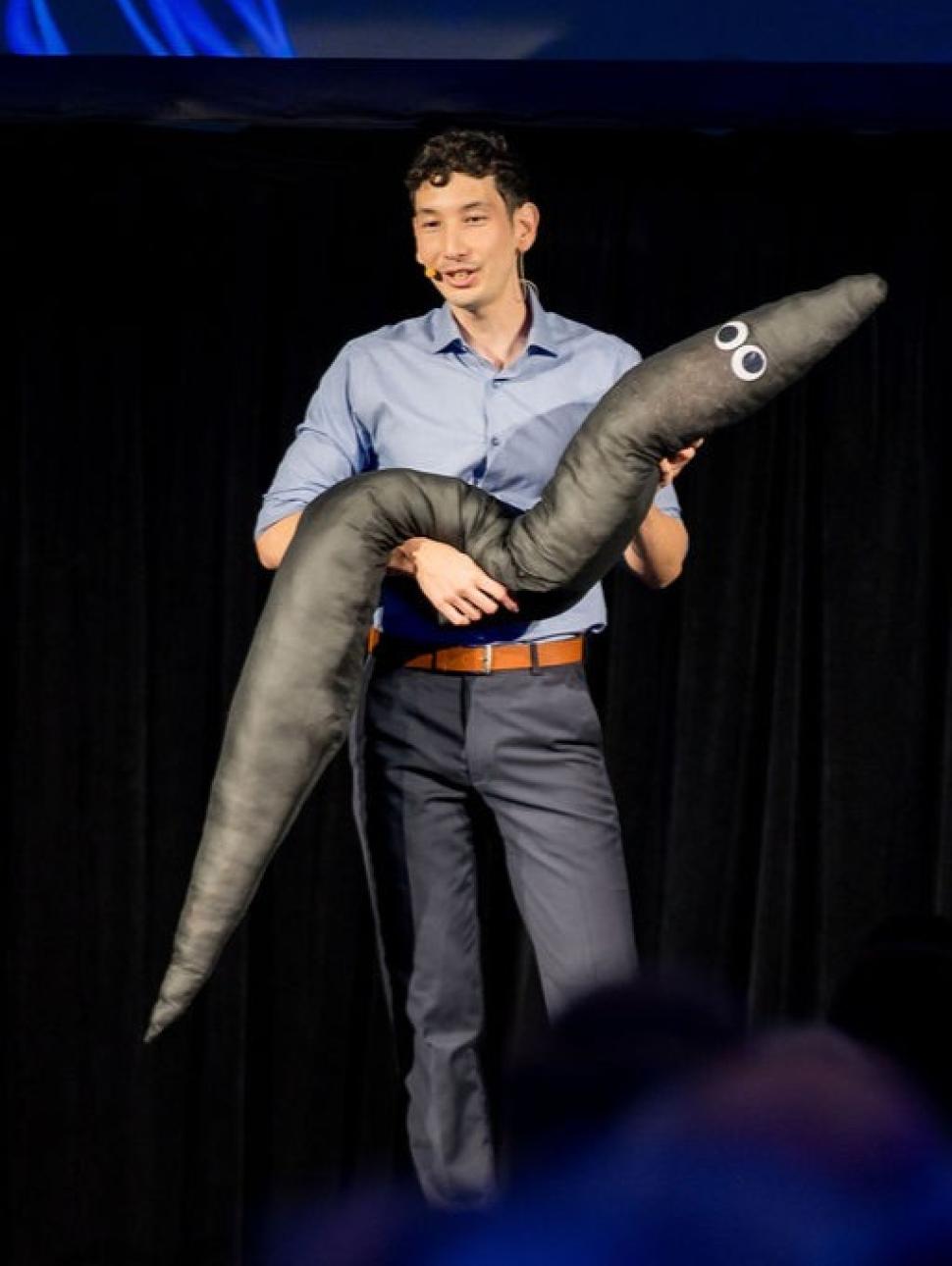
Competitors may use only the props they carry onto the stage. They might sing, dance or take their presentation in an unexpected direction. Whatever their approach, they have three minutes to win over the judges and audience.
Meet Australia's next generation of science communicators
Representing universities and research institutions from across the country, the 2026 finalists are exploring some of today’s most pressing and fascinating scientific questions.
Join us for an entertaining evening of science, fresh ideas and outstanding storytelling. Hear about the research shaping our future, support the finalists and see who will be crowned the 2026 national champion.
The winner will be selected by a panel of judges. The event will also be livestreamed across Australia and around the world.
About FameLab
Created by Cheltenham Festivals in the United Kingdom, FameLab is the world’s leading science communication competition. Since launching in 2007, the competition has expanded to more than 40 countries and welcomed over 40,000 scientists worldwide.
Event Timing (AWST)
5.30pm Doors open
6.00pm Event commences
7.45pm Interval & judges deliberation
8.00pm Winner announced
8.15pm Event concludes
Meet the finalists
Representing the Centre for Marine Science and Technology at Curtin University, Aimee is analysing more than two decades of underwater acoustic recordings to better understand the distinctive ‘bio-duck’ calls of Antarctic minke whales and what they can reveal about this whale’s behaviour and distribution.
Representing James Cook University, Alyssia investigates how tabletop gaming can foster social connection, creativity, identity exploration and mental wellbeing, challenging the idea that play is only for children.
Representing the University of Western Australia, Dr Harray is testing whether low-plastic diet and lifestyle changes can improve health outcomes in Australian adults, while working with farmers and producers to reduce plastic contact with our food.
Representing the University of New South Wales, Dr Shavrova explores why arachnids (like spiders, scorpions, mites, and ticks) evolve extreme reproductive strategies such as fighting, manipulation and sexual cannibalism, and how these behaviours shift across different environments.
Representing Curtin University, Dr Cham studies what happens to the human left in the loop when AI and automation alter what people do at work, and what that means for performance, safety and wellbeing.
Representing the University of Technology Sydney, Diana is using the predictable changes in bacterial behaviour, known as the ‘microbial clock’, to develop an AI-based model that can more precisely estimate time since death.
Representing the University of Notre Dame Australia, Kinta is investigating how repeated head injuries may trigger long-term immune changes in the brain that contribute to neurodegenerative diseases, like CTE.
Representing the NICM Health Research Institute, Dr Engel studies psychoactive plants and fungi to better understand their chemistry and use, bridging scientific research with public education and harm reduction.
Representing the Western Australian Organic & Isotope Geochemistry Centre at Curtin University, Morgane is reconstructing how extinct horned turtles lived and adapted on Lord Howe Island, and what environmental changes may have driven their extinction.
Representing the University of Technology Sydney, Niina is helping to develop patient-specific cardiac patches, containing living “mini-hearts”, to help regenerate damaged cardiac tissue in people with heart failure.
Representing the University of Technology Sydney, Nirmani is developing a strategic framework to help governments improve how technology is implemented across healthcare supply chains.
Representing the Adelaide University, Ollie explores how cognitive biases, emotion and experiences shape Australians’ perceptions of whales and dolphins, and whether these charismatic species can nurture broader interest and action for the ocean.
Representing Curtin University, Shanelle is developing SmartWheel, a semi-autonomous navigation system that acts as a cooperative co-pilot for powered wheelchair users, detecting hazards and identifying safe paths to reduce the cognitive load of everyday mobility.
Program Partners