
My Australia Story: Ciara Galega
For many university students and young professionals from diverse cultural backgrounds, the challenges of building a successful career in Australia can seem daunting, and perhaps insurmountable.
Is "working hard and being passionate" enough to help you find your dream job in a new country? New life, new path, new beginning… how can you achieve success in your career?
Ciara Galega, Founder and Executive Director of Daring Different Global, respected inclusion strategist, speaker, and community leader will, share her career journey as the featured guest in the first episode of the My Australia Story Season 3 series.
This session, chaired by Associate Professor Maggie Jiang from the UWA's School of Social Sciences, promises to provide invaluable insights into achieving professional fulfilment in Australia.
About Ciara Galega
Ciara Galega is the Founder and Executive Director of Daring Different Global, a lived-experience-led organisation advancing disability inclusion, cultural representation, and equitable participation across communities. Drawing on her own experiences as an African-Australian woman living with invisible disabilities, Ciara has become a respected inclusion strategist, speaker, and community leader committed to amplifying underrepresented voices.
With a background spanning media, community services, and disability inclusion, Ciara works at the intersection of disability, multiculturalism, leadership, and social impact. She is the founder of Amani Circle, a culturally safe peer-support and community connection initiative that brings together people with disability, chronic illness, carers, families, and community members to foster belonging, wellbeing, and meaningful participation. Through initiatives such as Amani Circle, the SUNflower documentary project, and the Daring Different Podcast, she uses storytelling and community engagement to challenge stigma, foster understanding, and strengthen inclusion.
Beyond her community work, Ciara serves in leadership and advisory roles across government and non-profit sectors, including the NDIS Quality and Safeguards Commission Advisory Council, the Royal Life Saving WA Disability Steering Committee, the Disability Advisory Council for the Federal Member for Cowan, and the Board of Mama Respond International. Her work focuses on accessibility, culturally responsive engagement, safeguarding, and ensuring lived experience informs policy and practice.
In recognition of her contributions, Ciara was named Inspirational Woman of the Year 2025 by the South Sudanese community and appointed Multicultural Disability Expo Ambassador 2025. Through her leadership, she continues to champion a future where disability, culture, and identity are recognised as strengths that enrich communities and civic participation.
My Australia Story Season 3
My Australia Story Season 3 is an interview series that provides a platform for remarkable first-generation immigrants to share their life and work experiences with the public. Initiated by Associate Professor Maggie Jiang at the School of Social Sciences at the University of Western Australia, this initiative is proudly hosted by WA Museum Boola Bardip.
-
Episode transcript
Maggie Jiang: Hello, welcome to Season 3 of My Australia Story, a series that celebrates courage, contribution, and the many ways people from diverse backgrounds are helping shape Australia's future.
Today, we are honoured to open this new season with Ciara Zita Galega a disability and inclusion advocate, public speaker, mentor, and communications leader whose work is transforming how we understand equity, safeguarding, and participation.
Ciara brings not only professional expertise across disability, youth, and aged care sectors, she brings lived experience. As an NDIS participant living with physical, neurological, and cognitive disability, she has turned personal insight into public leadership.
From her executive role at the Organisation of African Communities of Western Australia, to founding Daring Different, to advising international organisations on inclusive education and safeguarding, Ciara is not just participating in systems, she is reshaping them.
Welcome Ciara Can you take us back to early life and tell us about your journey to Australia? What were the circumstances that brought you to this country?
Ciara Galega: I was born in Yaounde in Cameroon. My journey to Australia was shaped by internal conflict and the need for safety and stability and the opportunity to rebuild. And so, at the time, Australia represented, stability, it represented where institutions and systems functioned, and also where the rule of law mattered opposed to where I came from. And I believed so much that if I contributed and worked hard, I would belong. And that's what Australia meant to me at the time.
MJ: Ciara, when you first arrived, what were your impressions about this country? People, culture, sense of belonging. Was there anything that surprised you, both positively or negatively?
CG: The first thing I noticed that struck me was how structured and organised Australia felt. Systems functioned, services existed and there was visible order. And what surprised me, however, was how multicultural voices were invisible. And it just painted a more picture about diversity, how diversity was present, but not always influential. And you could be welcomed socially, but yet very absent structurally. And so that distinction shaped my view about inclusion in Australia.
MJ: So, Ciara, since living in Australia, were there moments that made you feel this is home or this is not home?
CG: Good one. For me, Australia began to feel like home, not when everything became easy. But I realised I did not have to shrink myself, you know, as a person living with a disability or as a woman, because these were luxuries that I couldn't express in my country.
And so, Australia really started to feel like home when during governance conversations and leaders in respective departments of governance level started to really give me access and listen to my lived experience.
And so that really made us, made me in particular, feel seen and heard and started making Australia feel like home for me.
MJ: That's great. So, they listened and it's not just symbolic. They took actions.
CG: No, they took actions.
MJ: Right. Thank you.
So, Ciara, you have spoken openly about navigating your life as African Australian women, while also managing personal challenges that are not always visible to others. So how does migration culture and all this shape your identity in Australia?
CG: I'm an African woman. I am a migrant and a former media personality. And I personally am living with disabilities. These identities, they intersect. They do not only, they don't sit separately.
So, for me, migration heightened my awareness of structural inequities and disability deepened them and being an African Australian sharpened it.
So, for me, intersectionality is not just a theory for me. It is lived experience and it informs how I approach policy, system reforms and inclusion work.
MJ: Ciara, your career shift from media and acting to adequacy and policy reforms within a particular moment that pushed you towards this kind of shift?
CG: I began in media and acting and modelling, but storytelling has always been the centre of who I am. The shift into advocacy happened for me when I realised stories could reform systems. And after navigating misdiagnosis, cultural stigma and systematic blind spots, I recognised that advocacy is storytelling and storytelling translated into governance language.
I did not leave media in my opinion. I expanded it into advisory roles beyond the four walls of an office into policy conversations and institutional engagement.
MJ: Ciara, you found it very different as a lived experience led platform. So, what gaps did you observe in Australia's support system and multicultural landscape that made you feel this something needs to be done?
CG: Thank you for that. I found it very different because I observed a consistent gap. I observed lived experience was often invited into panels, into rooms, but really embedded into governance and representation was often symbolic.
So for us, it was very different. It was created to shift inclusion from awareness to institutional integration and from visibility to influence. And our work, which I am very, very proud of, spans between leadership development from the lens of not seeing disability as charity or weakness, but as advisory strength, advisory engagement, disability inclusion frameworks, governance aligned reform frameworks and models.
So, I am proud of the work that we continue to do, and I hope we continue to be here for a long time.
MJ: And you are doing great work. Thank you.
So, Ciara, you often say that representation should be systematic, not symbolic. So what do you mean by meaningful inclusion or what meaningful inclusion look like in your view?
CG: In my opinion, meaningful inclusion is not just about ramps. It is about who shapes the room, who drafts the agenda and who defines success.
So symbolic representation says you are visible. Systemic representation says you are influential.
But for me, real inclusion means you co-design. It means lived experience embedded at decision making levels and decision-making tables and rooms, not consulted after decisions are made.
So, it is very important for people to understand the distinction between real inclusion and representation.
MJ: I totally agree. Thank you.
So what are the challenges that you identify in translating your lived experience into policy making?
CG: My work suits the intersection of communities and institutions. I serve as the Director of Public Communications, Public Relations and Communications for a Peak Body, which is the organisation of African communities in WA. And my role involves with community awareness, stakeholder engagement and bridging dialogue between African communities and government systems.
I have collaborated in my span of work through Daring Different as well with organisations and institutions such as the Royal Life Saving Society, WA, to support culturally inclusive water safety awareness and accessibility conversations.
I have also worked with the union WA and that is to protect migrant workers' rights and persons with different disabilities from migrant communities to understand their rights when they work and contribute to such a beautiful country as Australia. These conversations actually really, really impact the community because it helps navigate and it helps promote inclusivity and integration at its peak.
MJ: So Ciara, over the years you have worked at the intersection between communities and institutions. So, from your experience, how do stories and the way they are framed that shape trust or mistrust between marginalised communities and public systems?
CG: That's a very good question because stories shape trust and if marginalised communities are only portrayed through crisis narratives, mistrust tends to grow and amplify. But when storytelling reflects dignity, capability, contribution, institutions become more accessible. They become more relatable. They become more friendlier.
And so, my work focuses on reframing narratives from deficit to capacity because narrative determines legitimacy and it is important that mainstream or institutions actually depict the value of how diverse the nation and the demographic of our nation is.
MJ: In your experience, many support systems and service systems rely on the narrow idea of credibility and visibility. So, what initiatives or approaches you have taken to shape this change behind it?
CG: Personally, I am part of the advisory group for COIN and that is led under Honourable Ayn Ali, which really embeds lived experience into core design and from the inclusion work that she carries through that department.
And also through my work through Daring Different, we have supported migrant workers in understanding workplace rights and what happens or who to call if they are injured or if they are transitioning to disability. And we have developed disability inclusive leadership conversations.
I am very strong at speaking publicly in panels and having those conversations to push the inclusion agenda.
And we have also consulted and gotten involved with organisations and I think the reason was when we partook in the Multicultural Disability Act. And so we gave our input as well.
For us, the goal at Daring Different and for me personally is structural participation, not just symbolic engagement.
MJ: So, Ciara, through your journey, what are the Australian values that make you feel supported or challenge you to grow?
CG: For me, Australia's strongest value is fairness. But with fairness, it was involved as demographics involved as well. The promise of a fair go must include intersectional realities, including migrant women with disabilities and culturally diverse communities navigating systems.
And so, Australia has challenged me in a lot of ways, and I have chosen to grow with it.
MJ: Ciara, looking back at the work you have done in advocacy and inclusion, what are the achievements you feel you are most proud of? And what are the results you see, are things you feel very proud of?
CG: I am not really one for accolades, but in this instance, I'm most proud of creating access and not titles, being invited into spaces, usually, especially advisory spaces where African and disabled voices were literally non-existent.
So, having that shift and that inclusion space is very much important in my community and helping and shifting conversations from awareness to integration, helping institutions see inclusion from a lens of strength, of performance and not of charity and understanding that we all are ably different and we all have diverse ability and we all have values to bring into this ecosystem, none is more than the other.
We have to co-exist and come together to have a contribution to our nation and to a country as beautiful as Australia.
MJ: Ciara, what would you like to say to migrants, women and minorities in this country who might feel unseen, unheard or misunderstood in the mainstream system?
CG: I would love to say your presence is not accidental, it is contribution. I know most of us come from communities and in countries where freedom, safety and advocacy is non-existent and so it embeds a lot of fear into knowing who we really are and our contributions and values but we have to also learn the language of systems, build alliances and have allies and not journey alone and understanding that access is not only about entering rooms, it is about shaping them once you're inside, it's about opening the door for many others to come and advocate.
One thing I love about it is we advocate not to tear down institutions but to ensure they reflect the nation as it has become and knowing that we are not here just to pass by. If this is home to us and when we call Australia home, you have a home, you protect it, you water it and you make sure that the foundation is strong and I want everyone to understand that, that your contributions bring value to Australia.
We have to protect it, we have to water it and just watch it grow for many generations to come so our participation into this country is valid and is expected and it should be included.
MJ: That's wonderful, thank you so much Ciara.
Ciara, thank you for sharing your story with such courage and clarity.
Your journey reminds us that leadership does not always begin with position, it often begins with a lived experience, with recognising gaps in the system and deciding to do something about them.
Through your advocacy, governance work, mentoring and public engagement, you're not only amplifying voices, you are strengthening safeguarding, shaping policy conversations and building more culturally responsive and inclusive communities.
We are grateful for your leadership and for the way you continue to transform lived experience into systems change. And this is what My Australia Story is about. Individuals who turns challenge into contribution and will help Australia become more equitable, more compassionate and more inclusive.
Thank you for joining us for the first episode of season three. We look forward to sharing more stories of leadership, belonging and impact.
Fiona McGaughey: It's a great privilege for me as Pro Vice Chancellor for Academic Advancement and Diversity at the University of Western Australia to support My Australia Story.
UWA is a special place situated on Whadjuk Nyoongar Boodja on the banks of the Derbarl Yarrigan River. Derbarl means mixing because it's where the sweet water and the salt water come together.
My Australia Story tells us stories of people mixing, people migrating here to Whadjuk Nyoongar Boodja.
This initiative is more than a storytelling platform. It's a powerful reflection of who we are as Australians. Our strength lies in our diversity and through these stories we hear of the lived experiences, resilience and contributions of people from a wide range of cultural backgrounds.
UWA is a microcosm of this and as a university we are home to staff and students from right here and from all around the world. We are deeply committed to creating an inclusive environment where every story matters. My Australia Story aligns closely with this commitment by amplifying voices that are too often unheard and by fostering understanding, connection and belonging. I am proud to support this initiative.
What makes it particularly meaningful is its ability to humanise diversity, to introduce us to the people behind the statistics and the politics. My Australia Story presents to us real stories that inspire, challenge and unite us. This is something that our society needs right now.
More Episodes
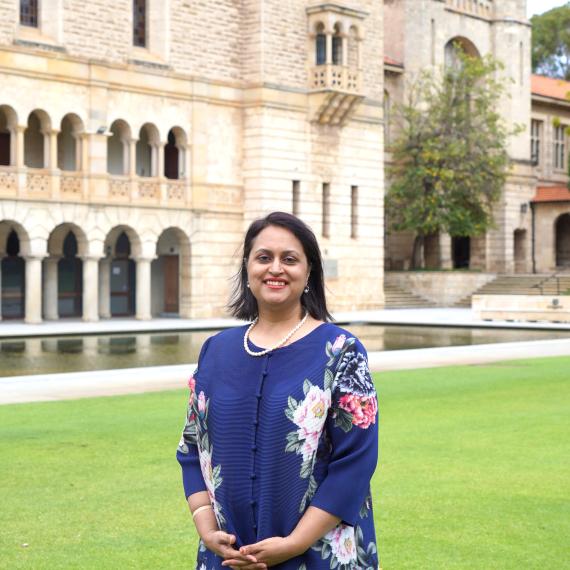
Nashid Chowdhury, Director of Global Growth and Advocacy at the University of Western Australia, will share her career journey as the featured guest in the second episode of the My Australia Story Season 3 series.
