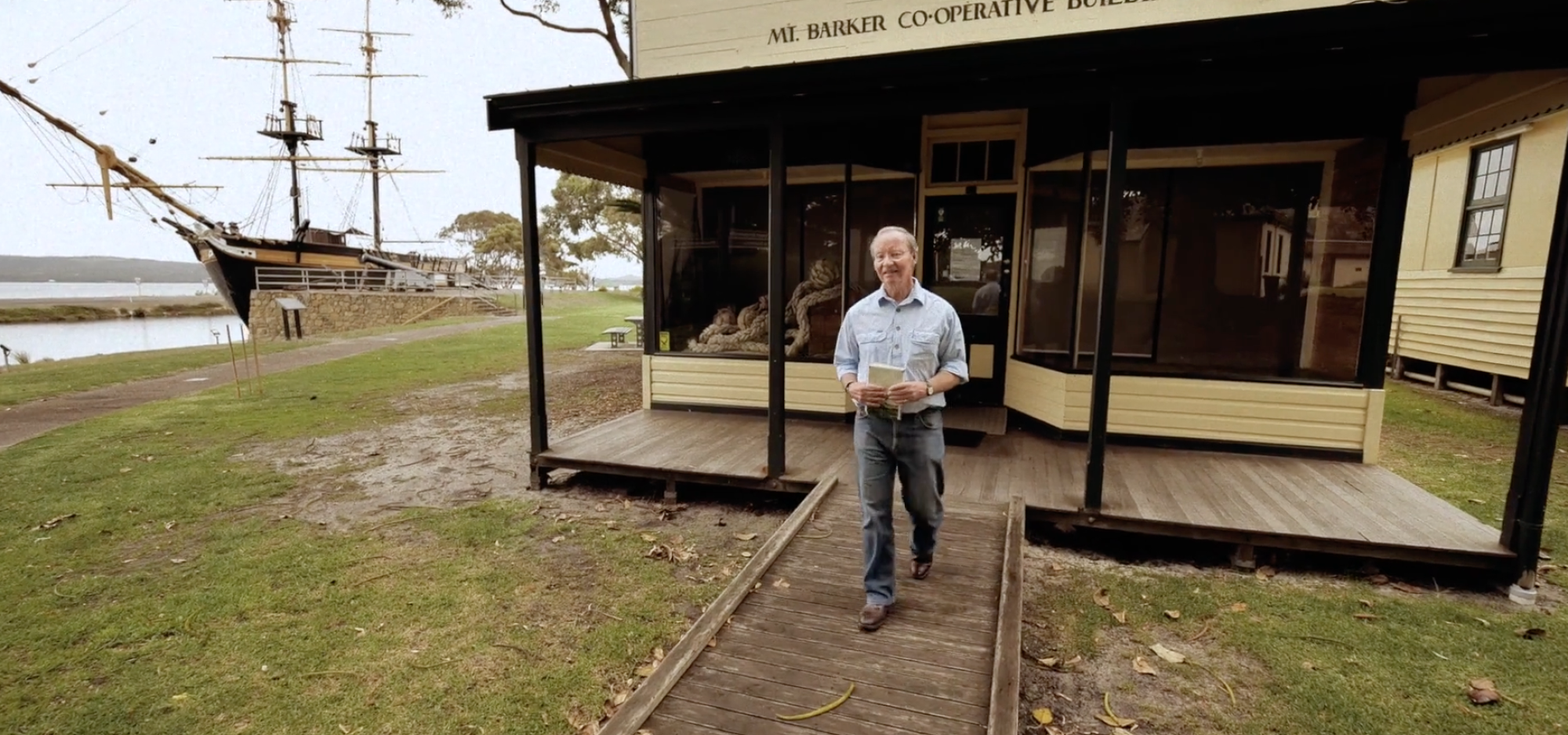
Albany Talks: Colonial Rivalry
In this video Albany historian Malcolm Traill explores some of the facts behind the rivalry that developed between Albany and Perth over harbours, railways and personalities.
-
Episode transcript
Welcome to the Curatorial series presented by the Museum of the Great Southern in Albany. I'm Malcolm Traill, and as well as being Programs Officer at the Museum of the Great Southern. I'm a historian who specialises in Albany history. Today I'm going to talk about a rivalry. A rivalry between two towns in Western Australia between Albany and Perth. Well, actually Albany and Perth and Fremantle.
That's just a little bit of background for those of you who aren't aware of Albany as a town. The European settlement was settled two and a half years before Perth was. Albany was first settled by Europeans in late December 1826. Perth, May / June 1829. So there's about two and a half years difference there. So Albany saw itself as probably quite rightly, the first settlement in Western Australia by Europeans.
And I found this quote when I was preparing this talk from the Sydney Monitor from 1835, and it talks about the comparison between Albany, once known as King George's Sound, and Perth. And it says, and you can read there on the screen, “Because King George's Sound and Swan River are, on the whole, better situated in a geographical sense and more free and independent than Van Diemen's Land was in its infancy …”
“… but the principal port ten years hence will be King George's Sound. Perth will sink into the Launceston of Western Australia and the Hobart town of the colony, i.e. Albany, will ultimately arise on the spacious and beautiful harbor of King George's Sound for the next 20 years. Both colonies are facsimiles of New South Wales in climate and produce, but the population being free will be less prone to drunkenness and crime generally than the two older colonies.”
So you can see there that the impression was, in Sydney at least, that Albany was going to be the preeminent settlement on the western side of the continent. So what about the reference to Hobart Town? Well, of course, there's always been a long rivalry in Tasmania between the South and the North, Launceston in the north and Hobart Town in the south.
And, I guess that rivalry continues much as it has between Perth and Albany over the years. Once, Launceston was actually first known as Patersonia, of all things. Paterson was the name of the birthplace, I believe, of Philip Gidley King, the second governor of New South Wales. And it was only changed to Launceston when Patersonia was thought to be a bit of a mouthful.
I think that's probably right. Well, Launceston is a town in Cornwall. And here's an image of Launceston from the 1860s. And this is what it looks like today. A pretty town. And, those of you who have been there, I'm sure you appreciate that. It's a lovely setting on the Tamar River. So let's get back to Albany or King George's Sound, as it was better known right up to 1832.
I mentioned Philip Gidley King, the governor of New South Wales. Well, his son, Phillip Parker King, was probably the best known of all the early Australian explorers. Well, certainly the first native born Australian explorer. He was born when his father was the governor of Norfolk Island, and he was a very well organised, very thorough explorer. He actually came to King George Sound three times, the first time in 1818 and then subsequently in 1821 and 1822.
And when he was here, he really did enjoy and appreciate the value of the Sound. And he brought with him a young surveyor who was to have a profound effect on West Australian history in colonial times. His name was John Septimus Roe. The Septimus indicating that he was the seventh son of a vicar from Newbury in Berkshire in England.
John Septimus Roe was the surveyor on the King expeditions and he was the first one to make note of the fish traps in Oyster Harbour. The Aboriginal fish traps that are a feature of Oyster Harbor still today. He did some exploring and very nearly lost his life on the first of those expeditions, when he actually tried to cross the Kalgan River, where those fish traps are situated, and he got into trouble.
The sands on the banks of the Kalgan are quite treacherous and quicksand-like. Weighed down by all his gear, his military uniform, he almost drowned. So the history of West Australia could have taken a very different turn had John Septimus Roe not been able to escape from that treacherous quicksand around Oyster Harbour and the Kalgan River.
In later life, Roe was to go on and become one of the main designers, I suppose, of European settlement in West Australia. As the Surveyor-General of Western Australia, he had a profound influence.
So getting back to King, he also influenced the fact that Albany perhaps didn't become the capital of Western Australia now. So as I mentioned earlier, he was a very thorough and meticulous observer and cartographer of all the land that he passed through, and he was given the instructions to actually call in to King George Sound, then to go to the Swan River and to chart that area with a view, I think probably, for the British to be settling there in a few years’ time.
He came to King George Sound, as I mentioned, with Roe. But, as he was sailing out or before he sailed out, the sailors on board his ship, the Mermaid, had discovered that the oysters in Oyster Harbor were excellent.
Indeed. And let me say, they perhaps overindulged on the oysters. So by the morning they were all pretty sick and unable to actually sail the ship to its full potential. King noted dryly in his journal that there was a bowel complaint. You can imagine what that was.
The bowel complaint continued amongst the men until after they passed the Swan River. At that time, there was still not enough fit men to actually sail the ship and anchor it. So King decided to skip that part of his instruction, and he sailed on. He next made landfall up at Shark Bay, so he never charted and plotted the Swan River.
Had he done so, he would have probably realised that it was quite sandy. It was hot. There was not regular rainfall, and it was probably not the best place for a settlement. Now, this is unlike the surveyor who actually did survey the Swan River, who later became the Governor of Western Australia. The first Governor, Sir James Stirling. Sir James was keen to establish the settlement, and he was keen to make his mark on Australian history.
He was a young, up-and-coming naval officer who'd actually lost his job after the end of the Napoleonic Wars. He brought with him his young and beautiful wife, Lady Ellen Stirling. But in his early surveys and mapmaking, he was a little bit cursory in his explorations and in his journals. And he concluded that the Swan River was actually a beautiful place.
Well, it probably was at the time of year that he came, which was about September. He noted that trees grew well. He noted that the soil seemed appropriate and that there was a river, the Swan River, which would be useful for transport. But he I think he had an ulterior motive. I think his ulterior motive and many others have agreed with me on this, revolved around his wife or actually his wife's family.
This is his father-in-law, a wily politician and wheeler-dealer in England named James Mangles. His nickname was Old Potato Face. I guess we can see why, but James Mangles actually had interests in India through the British East India Company and his son, also James, was the owner of a couple of ships, a small fleet of ships, and the Mangles family were very keen to establish a port on the west coast of Australia, i.e. the Swan River.
So their son-in-law James probably was somewhat coloured in his explorations, and his reporting to the government, when he said that there would be excellent port facilities at the mouth of the Swan River. This was not exactly true, as we'll see a little bit later on. So the reports went back to London, and James Stirling was authorized to establish a settlement at the Swan River, even though King George Sound, Albany, had been established two and a half years earlier and was doing quite well with a small convict garrison and settlement there.
So the settlement of the Swan River Colony, later to become Western Australia, was established in June 1829, with the initial Lieutenant Governor, James Stirling, in charge. The settlement at Albany was a separate military establishment run from New South Wales. They reported to Sydney, but by 1831 that settlement had been superseded. They were ordered to abandon the settlement as a military garrison to return the soldiers and convicts to Sydney, and the settlement of Albany would decrease in size and would be run by free settlers.
So already we've got Perth displacing Albany, and already there's some animosity between the struggling small number of perhaps 30, 40, 50 settlers in Albany and the growing establishment on the Swan River. Not that Stirling didn't like Albany. He saw the potential of Albany, and very sensibly, he spent many of his summer holidays in Albany. He established the first farm in Albany and stayed there, and even suggested that the port of Albany move from Princess Royal Harbour into Oyster Harbour.
The site of all those oysters from earlier years. And he established or proposed a new town site. And here's a picture of that town site that he proposed. He named it Wyndham. It's a far cry from the Wyndham that we know now in the Kimberley, but we could have had a Wyndham on the south coast of Western Australia as well.
But Stirling was keen to maintain the Swan River Colony, and that was his orders as the preeminent town and capital of this new colony of Western Australia. But he was the one that gave Albany its name in 1832, previously known as King George's Sound or just the Sound, sometimes known as Frederick's Town unofficially, but he was keen to actually name it after the Duke of York and Albany, and he promulgated that in 1832.
Even a little bit later on, around that time, a lot of good things were said about Albany. It had this magnificent harbour, which is something that Perth and Fremantle lacked. And here's a quote from a traveller named James Hanson, who was a travel writer, and he was writing about Albany in the early 1830s. “After it attains anything like comparative respectability as a settlement, it will, I'm confident, supersede the whole of the Australian colonies east of it.”
“The Sound is blessed with a climate it is impossible to eulogize too highly.” How's that for praise? But despite people like James Hanson, the colony in Albany struggled. The soils were not good for growing things. Vegetables and food crops struggled, despite the fact that the indigenous population, the Menang, were quite welcoming of the newcomers and there was a harmonious relationship between them.
There was no investment from the Swan River Colony or from London. Albany became known for many years as Sleepy Hollow, but things changed around the 1850s.
Much to the disappointment, I guess, of Perth and Fremantle, because Albany, with its harbour, the Princess Royal Harbour, became the preferred destination of shipping from both directions. From the west, from Europe, and from the east, from the eastern colonies, Sydney, Melbourne, Hobart, and Adelaide. Albany really got up the nose of the Perth establishment, and the government when the P & O Company, the biggest shipping company in the world, gained the mail contract for Albany and set up a depot.
Now the mail contract was vital. This was the conduit for news from home, from the home country. Everything came through pre-telegraph, pre-internet, pre any communication. Everything came by mail. So the voyage at that time around the Cape of Good Hope could take anything from 6 to 8 weeks until the Suez Canal was built in the 1860s, which shortened the distance somewhat.
The editorials in the Perth newspapers fulminated against Albany, and this decision that was made in 1852. The Inquirer, one of the two newspapers in Perth, wrote in their editorial, “The colony will lose in every way it will lose by not having regular postal communication. It will lose by not possessing safe postal communication. For what banking company, merchant or private individual would forward remittances or consent to receive remittances via King George's Sound?”
“It will lose by a heavily increased expenditure and it will lose in consequence of the non-arrival of those passengers, settlers or temporary sojourners who might be expected inconsiderate considerable numbers if the steamers called at Fremantle.” And finally, the Inquirer went on to say in this editorial, “By all the vessels touching solely at the Sound (King George's Sound), we are as much benefitted as if they made Dirk Hartog’s Island their place of call.”
Strong words indeed. And I'll just refer back to that mention of steamers, because at this point in the early 1850s, steamers were replacing sailing ships as the main mode of transport. Steamers were more reliable. You didn't have to rely on the wind. And with the P & O setting up their depot in Albany, they set up a whole coaling industry to fuel these steamships, which came in regular and ever-increasing numbers through the 1850s, 1860s and 1870s, because at that time, although Fremantle had actually had a port, it was not the port that we know today.
It was a port in Cockburn Sound, which for much of the year was unsheltered when the westerlies blew. Albany, as you can see from this slide, had a secure harbour with jetties and the activity going on in this picture of the Deepwater Jetty in 1900, a little bit later, is phenomenal. In the 1890s, Albany benefited by the gold rush in the goldfields of Western Australia because thousands upon thousands of gold seekers came from the eastern colonies, escaping a depression, escaping hard times there. In search of the lure of gold, they would hop off the ship at Albany in numbers of up to 500 a week.
Then they would either stay in town for a little while or head up the railway line and hop off the train and go cross-country to the newly opened up goldfields of Coolgardie and Kalgoorlie.
Fremantle and Perth lost out. They had the Long Jetty in Fremantle. Now, the Long Jetty was a bit notorious and it battered sailing ships and steam ships when these winds blew. These winds would batter these ships as I said. So ship's Masters were very reluctant to come to Fremantle given those port facilities that were there. They were much happier to come to Albany.
And let me read the thoughts of one of the Masters of the ship named the Saranac in 1892. Captain D.B. Shaw, talking about Fremantle, “Gentleman,” and writing to his head office in New York. “Gentlemen, I have been in a good many places in my time, but this is the worst damn hole I ever saw. The stevedores are half drunk all the time and don't care what they do.”
“The ship has to feed them and give them all the money and tobacco they want or they will make trouble. They are a dirty lot.” A week later, in November 1892, he wrote again.
“I was never so sick of a place in my life. And may the curse of Christ rest on Fremantle and every son of a bitch in it. God damn them all.” But politely, he signed off. “I remain, gentlemen, your obedient servant, Captain D. B. Shaw”. So you can see the animosity and acrimony that Fremantle bred in some ships’ captains.
The mail coming into Albany was a long way away, and especially up until about the late 1880s. It was a six-day trip on a sandy track by coach to bring the mail from Albany to Perth. It was an epic journey, and when the mail coach finally ceased in 1889 when the railway opened, those in Perth breathed a sigh of relief.
But that was also part of the animosity between Albany and Perth.
The railway wasn't funded by the state government. They didn't have the money. The railway had to be funded by private enterprise. So even then the state government didn't put money into infrastructure and transport between the capital and the south coast.
Regular editorials and regular letters to the paper sniped at each other from a distance, of course, between the virtues of Albany and Perth. Albany folk - they thought they weren't getting a fair go. They thought all the money was going to the west coast, and this was especially the case when John Forrest rose to the premiership of West Australia in the early 1890s.
Sir John Forrest, one of the biggest influences in Western Australia in colonial and early federal times. He was a big man in more ways than one, a big personality and big physically. Big John Forrest had made his name as an explorer in the early days with his brother Alexander then had gone into politics and had dominated politics on the west coast of Western Australia for all that period. And when he became Premier, he was determined to bring Western Australia out of the doldrums.
They had a resource, they had gold, they had money very much like today. So he was determined to turn this resource into infrastructure and build a colony that would be the envy of many. But he realized that one of the main problems of Western Australia was, of course, the distance between its towns, between its resources. Not only the distance of a six-day coach ride between Perth and Albany, but the distance between the goldfields and the coast.
So he realized he needed an engineer, and he found one in this gentleman, Charles Yelverton O'Connor, an Irishman who'd been working in New Zealand and had established a big reputation for difficult jobs. He built a harbour and a railway on the west coast of the South Island at a place called Greymouth, which people said couldn't be done. He achieved it.
So when Forrest was looking for an engineer in chief, he hit upon C.Y. O'Connor as the obvious candidate. And when C.Y. O'Connor was appointed, he and his family moved to Perth. But before moving, he sent a telegraph to John Forrest asking what his job was. “What do you want me to do? Railways? Roads? Pipelines?”.
The answer came back from John Forrest. “Everything.” So when C.Y. O'Connor arrived in 1891 - he actually ironically arrived in Albany - he found that Albany was a place which was riven with dissension and with argument. And much of the argument revolved around this man here, Lancel De Hamel. So who was Lancel De Hamel? He was a lawyer from England. Small, wiry, outspoken, charismatic, not afraid to make a fuss and rub people up the wrong way.
And he realized when he came to Albany as a lawyer that Albany was getting what he thought, and many of the townspeople thought, was a bit of a rough deal. And the rough deal was based around the railway line. Now, this railway line, which was built by a private company named the West Australian Land Company, was headed by an entrepreneur from Sydney named Anthony Hordern.
They did a deal with the government to build this railway, but in exchange for building the railway, they were granted land on either side of the railway, going all the way from Albany to York, and from there the line was already established between York and Perth. The deal was that the company would receive land which they could subsequently sell off.
Sounded logical, sounded reasonable, and a good deal for the West Australian government. But when Lancel De Hamel came to power and realized that in Albany, this land swap meant that all the land alongside the railway line between the town and the town beach and the harbour would be owned by the railway company, and they weren't about to give it up.
The town was then cut off from its beach and from its port. De Hamel took up this cause and quickly got the town behind him.
The council was divided and De Hamel seized his opportunity. He set up his own newspaper, the Albany Observer, and when the council all resigned en masse, he stood for Mayor and he became the Mayor of Albany. He was not only Mayor, but he was also head of the local militia. So he controlled that part of the establishment as well.
And he had running battles with the Governor and with Perth. Not content to be just Mayor, he stood for Parliament and became a member of the Legislative Council. He probably realized in retrospect, perhaps, that this wasn't such a bright move, because it was much more difficult to actually sway the Legislative Council, and his influence was diluted somewhat. But he had running battles with the Governor, Frederick Broome, over the railway line.
Eventually De Hamel, and the townsfolk managed to get some concessions from the railway company and the government, and were able to put in level crossings between the town and the beach over the railway line, but not before Governor Broome left office. He actually left to go back to England from Albany, and the tradition was, quite rightly, that departing Governors would be accorded a civic reception in Albany before they left the colony.
De Hamel made sure that Governor Broome never got such an honour, and all he got was a small wave goodbye on the ship when he left Albany to return to England. So you can see that that animosity really reached fever pitch at that time. What happened to De Hamel? Well, that's a bit of a sad tale.
I think he probably overreached himself. And he decided that, once he was beaten in the mayoral contest in Albany, and I think he also stepped down as a Member of Parliament, he decided to try his luck on the goldfields as well. So he took his wife and young family to the goldfields, where all contracted typhoid and died in the goldfields of Western Australia.
A bit of a sad ending. Notwithstanding that, Sir John Forrest was still in power, he empowered C.Y. O'Connor, as his first task, to build a harbour in Fremantle. As I mentioned earlier, Fremantle thought they had a harbour, but it was actually Cockburn Sound, which was outside the Swan River. Why couldn't they use the Swan River? Well, there was a bar across the mouth of the river of limestone, which had proved impossible to breach, so only the ships with the narrowest draft could sail over this bar.
O’Connor thought of radical ways of actually removing this bar, which involved new techniques of blasting. He was lucky, I suppose, in the fact that during the time he was here, dynamite was developed by an inventor in Sweden named Alfred Nobel. So O'Connor employed dynamite to actually blast the limestone bar to oblivion. Some of the locals in Fremantle objected to this blasting.
The sidewalks were rattling and their roofs were being peppered with limestone, but he achieved his aim and he succeeded in creating a safe harbour in Fremantle, in the mouth of the Swan River, by blasting the bar and building two moles out into the Indian Ocean, the South Mole and the North Mole, which protected the entrance and protected the shipping.
It was a great breakthrough for Perth, for Fremantle and for John Forrest. It meant that ships could be rerouted from Albany. The mail contract was reassigned to Fremantle in 1900. The harbor at Fremantle had opened three years earlier, so Albany had lost an awful lot of its shipping traffic at that time, and with that building of Fremantle Harbour, O’Connor went on, and we'll talk about him in a minute.
But to Forrest and his next political achievements and dealings at that time. In the 1890s, there was a big move for Australia to become one nation, a federation of the states and colonies. Western Australia had been granted statehood in 1890. They had become relatively independent from Britain, and the next logical step was to join the Federation of New South Wales, Victoria, Tasmania, Queensland and South Australia and become one nation of Australia.
Forrest was not so keen on this idea that Western Australia, by its distance from the centres of power from Sydney and Melbourne, would miss out and he held out for a better deal. For many years he advocated for West Australia to stay outside this federation.
Albany was not really part of this debate. I suppose, but it went on and eventually there was a referendum nationally to decide on whether the states would join into one federation. And in Western Australia it was overwhelmingly voted that, yes, we would join the Federation. Forrest, the canny politician that he was held out for some good deals for WA.
But even so, and you can see on the federal poll tally board from the West Australian from July 31st 1900, that the YES vote was overwhelming, 44,600 to 19,600. But if you look a little more closely at those figures, if you can, you can see how the different areas were divided. That Albany had voted strongly in favour of Federation.
I think it's 914 to 67 and the goldfields areas around Coolgardie and Kalgoorlie also voted very strongly in favour of joining the new federation. But the farming areas and the Kimberley, the rural areas and the regional areas, which were agricultural in nature, opposed this. They could see problems for this colony, for their produce, for their isolation. It was the Goldfields and Albany and the influence of these states that I mentioned, all of those people that came from the eastern colonies in the early 1890s, who swayed this vote significantly towards Federation for Australia.
So there's another example of Albany going against the grain of going against the wishes of Perth and Fremantle and the metropolitan areas of actually doing its own thing and swaying that vote into a significant YES to join that new Federation of Australia, which took place, of course, on January 1st 1901. By this stage, getting back to C.Y. O'Connor, he'd moved onto his next project under the patronage and assistance of John Forrest. He realised that one of the major drawbacks of the mining areas around the goldfields of West Australia was the lack of water, and this was having a profound effect on the health of the miners.
Typhoid and cholera were rife, and the health service and system was breaking down. Deaths were regular and many, so they needed a good supply of fresh water. So Connor came up with this idea of piping water from the coastal areas all the way, six or seven hundred kilometres, to the goldfields. They said it couldn't be done. But O'Connor, with a series of pumping stations and with the new invention of stainless-steel pipes, created this grand design of a pipeline from Mundaring Weir in the foothills all the way to Kalgoorlie.
Now, he had a lot of critics along the way, and especially the media, who saw this scheme as a folly, as a waste of state's money, of a vision that could never be achieved. O'Connor took this very personally, and he no longer had the backing of his mentor and guide, Sir John Forrest, who had then moved into federal politics as the Minister for Defence.
Forrest was removed from the metropolitan centres of Perth and Fremantle, and O'Connor was defenceless. Eventually, it all got too much for him, and one fateful day he decided to end his life, which he did by riding his horse out on the sands of Fremantle, as he did every morning, taking a gun with him and shooting himself. It's a sad end to a great life.
And along the lines of De Hamel, I suppose the tragedy should never have happened. And although it's not really part of the Albany story, it's a part of Australian history story, and his life is celebrated by the beach where he ended his life, and some amazing sculptures that are there on the beach by a West Australian sculptor named Tony Jones, showing O'Connor on horseback and his last ride.
It was a tragic tale from the early 1900s. Albany I think I stood still. Perth and Fremantle had their ups and downs, but generally went ahead and became the metropolis that it is today. A large metropolis. Albany, of course, still had its harbor, its reason for being, but it lost its passenger trade.
And today, as you can possibly see from this picture, it's very much a freight port. It exports cereals, wheat, barley, lucerne, it exports woodchips. That's that large pile that you can see in the middle distance. So the port remains but much subdued compared to Fremantle, of course the main port of Western Australia. So the main rivalry between Albany and Perth was over the port.
This is how it came down over all those years. But interesting that nowadays there's great debate about Fremantle Port. It's still necessary, but should it still be in the Inner Harbor, which O’Connor built 120 years ago, or should it be moved into back to Cockburn Sound? Should a specialist port and containers have terminal be made? So debate goes on.
And in 2018, 2019 and 2020, you can see that there's still a great debate about the future of Fremantle Port in its present position. That doesn't concern Albany so much. Albany goes on, but I've often speculated as to what would have happened had Albany become the capital of Western Australia, as it possibly should have been, given that it was the first European settlement on the side of the continent. What would it look like?
What would the size look like? So I've superimposed maps of Greater Perth and Greater Albany. So Perth, with a population of something over 2 million, takes up an area of about 6400 square kilometres. If you're familiar with Perth, you'll realize it stretches from Yanchep or further north down to Mandurah in the south. It's bounded and bordered by the Darling Range, named by Stirling after the Governor of New South Wales all those years ago.
So that's its natural boundary. It's a long coastal strip. What would happen if we superimposed that area? And I've turned it on its side so we can actually see it in context, in the context of the south coast facing Albany. What would happen if we superimpose those 6000-odd square kilometres over the Albany region? And how would that fit?
Well, this is the area that it would actually take, right? It would stretch from west of Denmark, all the way up to north of the Porongurups, and east to Cheyne Beach, and out towards Wellstead. It would stretch almost to the Stirling Range. That's the area. That's the area of 6418 square kilometres that the metropolis of Albany would take in.
Isn't that incredible to think that if things had been different, if Stirling hadn't been there with his family in the background, if Forrest hadn't insisted on appointing an engineer with talent who could build a harbour for Fremantle, would Albany have become the capital and largest city in Western Australia? Just ponder that for a minute and what the effect would have had on Albany and also on Perth.
It's a colonial rivalry that's gone on for many years, and even now there are a few little niggles in a friendly way, not with any animosity. And I think we in Albany are probably grateful for the fact that we are the capital of Western Australia. Thank you for listening.
More Episodes
Join Dr Tony Friend, Research Associate, DBCA to hear about the conservation story of Gilbert's potoroo.

Go behind the scenes of Albany Then & Now: Historical Panoramas of Menang Noongar Boodja exhibition.
In this video Albany historian Malcolm Traill looks at the influence of the Chinese in Albany and throughout Western Australia, from their first arrival in Sydney over 200 years ago to the present day.
In this video Albany historian Malcolm Traill looks into the lives of those families and individuals commemorated in paving stones in one block of Stirling Terrace.
In this video Albany historian Malcolm Traill explores some of the myths, legends, and ghost stories that have grown up around Albany over the last 200 years.
In this video Albany historian Malcolm Traill discusses the hidden history of submarines in Albany.
In this video Albany historian Malcolm Traill discusses the history of quarantine in Albany.

In this video Albany historian Malcolm Traill looks at the 1920s, a decade of heightened optimism in Albany after the trauma of World War One.
