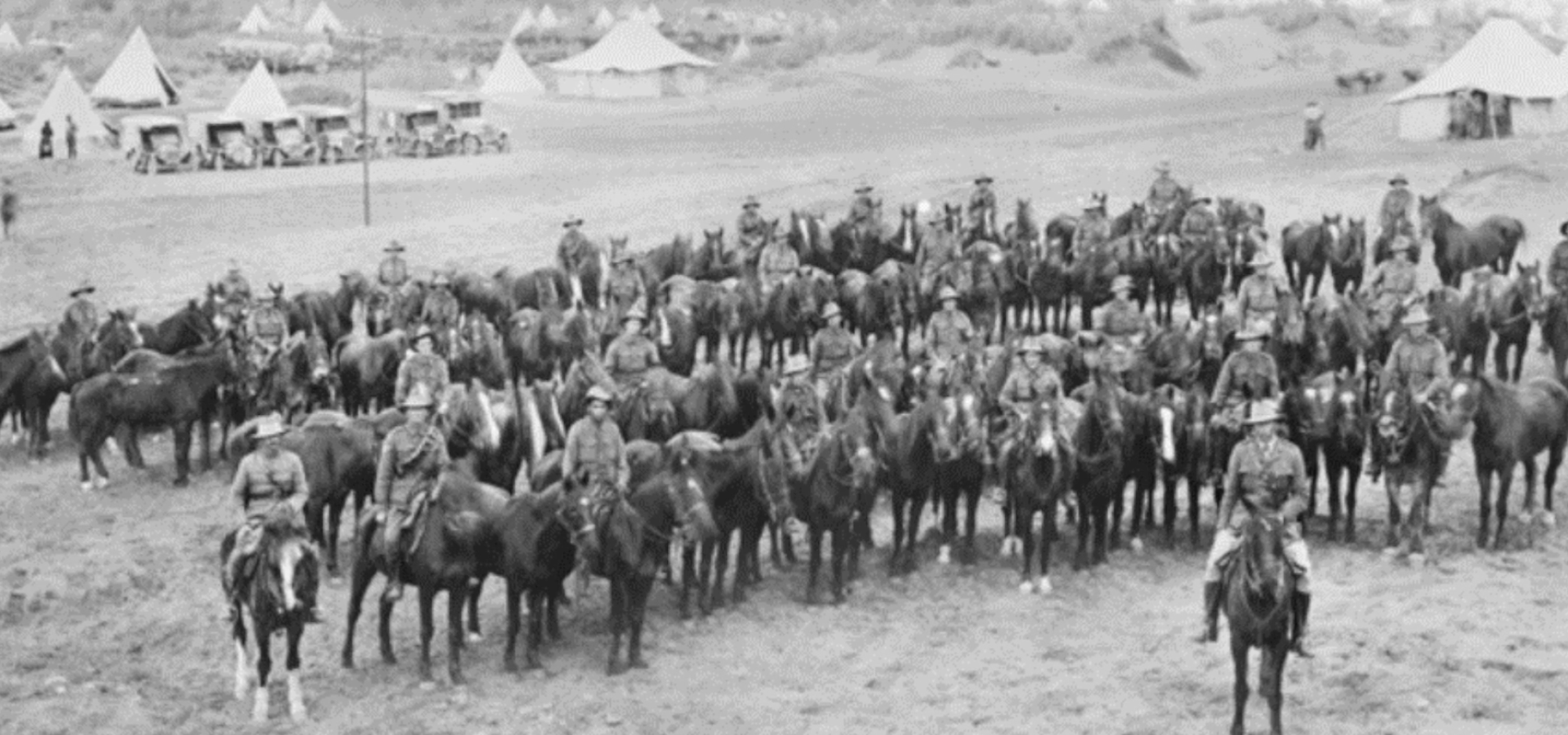
Albany Talks: Myths of Albany
In this video Albany historian Malcolm Traill explores some of the myths, legends, and ghost stories that have grown up around Albany over the last 200 years.
-
Episode transcript
Hello! Welcome to the curatorial series produced by the Museum of the Great Southern in Albany, Western Australia. My name is Malcolm Traill. I work there as Programs Officer, but I'm also a historian who specializes in Albany history. And today, for you, I thought I'd talk about some of the myths and legends around Albany. Some true, some false, some with a grain of truth in them, like all myths and legends.
I think that's the case. And some ghost stories as well, to finish off with. Every town has its own ghost stories. So where do we start? Well, probably with the name of Albany itself. Where does Albany come from? Well, it was probably the third choice for the name of this town. Only officially named in 1832. The first settlement by Europeans in Albany took place in late 1826.
And it was a convict garrison set up, probably to forestall the French plans for setting up a similar establishment on this side of the continent. But the myth and the story that I want to look at right now is the name of this place, because the original commandant of the settlement, an army major named Major Edmund Lockyer, preferred the name Frederick's Town for this area.
And in his reports back to the Colonial Secretary, Macleay, he writes that, “On the 21st instant [which was the 21st of January, 1827] the colours were displayed under the usual formalities, and have ordered until the pleasure of His Excellency. The Governor shall be made known that the site fixed on shall be called Frederick's Town, in honour of His Royal Highness the Duke of York.” His name was Frederick.
So was Albany known as Frederick's Town? Well, yes and no, like all of these myths and legends and stories.
Lockyer preferred Frederick's Town, but it was never formally adopted. You can see there that he wrote, “Until the pleasure of His Excellency the Governor be made.” Fine. Well, the Governor never made his pleasure known, and the site remained very much under its original name as King George's Sound, which is the name of the waterway outside the town.
It wasn't until 1832 that Governor Stirling, the Governor of the Swan River colony, which wasn't even in existence when Lockyer wrote this in 1827, Sir James Stirling decided that the name of the town should be officially Albany. So Frederick's Town was never officially adopted, but certainly colloquially known and preferred by Major Lockyer, His Majesty's 57th Regiment. That's the Frederick's Town story.
Now, what about this story that was around and about for a long time, involving the Boer War and the Albany Town Hall. Now, this picture of the Albany Town Hall is quite historic and can be pretty precisely dated, because we can see in the tower of the Hall there's a spot for a clock, but there's no clock there.
And this is part of this story. The clock was installed in 1891, whereas the hall was built in 1888. We didn't have enough money to put a clock in the money for the hall. Spent the entire council budget for one year. So it's not surprising we had no money for the clock. Anyway, the clock was later installed and you can see in this picture here that it's there and in all its glory.
But on the south face of the clock, for many, many years, there were some bullet holes. And the story was that the bullet holes were put there by returning soldiers from the Boer War.
Apparently. And this is difficult to confirm, but we'll run with it. Apparently, one soldier challenged another that he couldn't hit the face of the town hall clock from his rifle. From the foreshore, which is a distance of about five or six hundred metres. The challenge was taken up and was successful. He hit the Town Hall clock face with a couple of bullets producing bullet holes.
So for many years after 1902, this is when the troops returned from the Boer War. For many years there were these bullet holes in the south face of the Town Hall clock, and they were impossible to fix because you need a scaffolding to get up there. So there they remained. The name of the soldier is unknown, and the name of his challenger also.
But certainly that's where they originated.
Again, at that time, in 1902, there was a bit of a minor riot in Albany with again returning soldiers from the Boer War. And this incident, so we call it an incident, was known or became known as the Sacking of Albany. So what exactly happened in the Sacking of Albany? Well, it seemed that a number of troops returning from the Boer War en route to Sydney and Melbourne, their home cities, got a bit boisterous and I guess became a bit overenthusiastic and did a bit of damage around town.
This seemed to be blown out of proportion and became national news. This article came from the Sunday Times in Sydney, New South Wales. But you can actually see in another article from the Clarence and Richmond Examiner, which is in the northern parts of New South Wales, that this Sacking of Albany certainly became national news.
The report read, and you can read this. “Apparently the returning Australian soldiers who were in the orgy must have mistaken some of their countryman's homes for Boer farmhouses. As, according to reports, some of the men stole jewellery, innumerable smaller things, a sailing boat and two dinghies, and even broke into a woman's room and robbed her of her money.”
“It has been called the Sack of Albany, and evidently, if not exaggerated, some of the Albany offenders, some of the Albany sack, must have got into the notice of the offenders. And the best thing to do now is to seek them in real earnest.” It became a major national incident, the Sacking of Albany. Apparently they used some of the mirrors in the Royal George Hotel as target practice, and shot them as well.
They were going to be denied their chance of a victory parade in New South Wales, and an inquiry was put forward under the command of Colonel Lasseter, and the inquiry found, quite amazingly, that the troops were not responsible for this Sacking of Albany. That it was down to sailors who had stowed away on the ship, had stolen uniforms and created this chaos and havoc.
Now to me, that sounds extremely convenient. And, they were allowed then to go ahead with their victory march and celebration and welcome home in Sydney. But the Sacking of Albany had repercussions, I believe, later on, because when the Anzac troops en route to the Middle East and Gallipoli in late 1914 came through Albany, they weren't allowed on shore except under strict supervision, because I think perhaps there were memories of the Sacking of Albany, which had happened just 12 years earlier.
Now here's another little myth. Perhaps that isn't entirely true, and it does revolve around those Anzac troops who left here in late October, early November 1914, and subsequently at the end of the year, in those two convoys that left Albany to sail to the Middle East. Now, of course, on board, were many horses which were part of the cavalry regiments of the Australian Army, the Light Horse regiments.
And here's some pictures of horses being loaded for the Australian Eighth Australian Light Horse Regiment. And the story goes that many of these horses were loaded at Albany. Well, that's not entirely true for those convoys that passed through in late 1914. Most of the horses had come from other states and were already on board. Now some were taken off at Albany just for exercise, but none were loaded on that initial convoy.
Similarly, for the men all on board, no West Australians were loaded onto ships in Albany. They were loaded in Fremantle. So the stories of the horses coming onto the ships at Albany for those initial convoys are not entirely true. I'm sure many later on were loaded, and many families were involved in breeding horses for the war efforts in the later years of World War One.
But I believe the only horse that was loaded on in Albany was a replacement for a mare who was found to be pregnant on board. So she, lucky her, was offloaded to Albany and her place was taken by a single horse. Now, there's many stories in Albany as I think they possibly are in other cities around Australia of tunnels, of a network of tunnels that were supposedly built by convicts to escape or to smuggle sly grog around the town.
And some of these stories in Albany revolve around this building. What we know as the Old Post Office. This was built originally in the 1860s, added to in the late 1890s, and being the post office was very much the centre of town. The centre of communication was the telegraph office, and it also doubled as a customs office as well.
Now, that's perhaps a clue to some of these stories, because one of these stories I've heard is that there was a tunnel running from the Customs House to one of the taverns in town, and grog would be rolled up in barrels up and down these tunnels and convicts would also use these tunnels as well. Now, look, I think this is a figment of people's imagination.
And looking at these pictures of the Old Post Office today, you can get a feeling of the site, perhaps of this building. It's built on a hill and much of Albany needs good drainage.
The city of Albany is also built on a lot of granite, so building tunnels and any sort of drains is quite a major occupation. I just can't imagine anybody building tunnels for human access through this granite. And I think a lot of these stories come about through the Old Post Office is that there was an extensive system of drainage put in. Drainage to take away water from the hill above Mount Clarence, which ran downhill to the harbour.
So I think that's where a lot of these stories come from in terms of drainage and drainage tunnels to take away excess water, but not as a transport route for grog or convicts. Is that a good explanation? I think that's one that makes sense. And another one that pops up regularly are tunnels around the Fortress in Albany.
The Princess Royal Fortress. Now, this fortress, if you're not familiar with Albany, has been part of the landmark of this place since 1893. It was a federal fortress, one of the first fortresses built around the coastline to protect us from invasion. It had a grand lookout point, and amongst this lookout there were stories that there were tunnels running under the hillside from gun emplacements off the top of the hill, Mount Adelaide, to the bottom at the entrance to the harbour.
And the story was that tunnels were used here for the transport of ammunition and also for communication. Well, I think the story is half right. There's half a grain of truth in this because they were not tunnels, but trenches dug around this site, and especially during the two World Wars. These trenches were camouflaged. And you can see in some of these pictures how effective that camouflage was.
So certainly the trenches were there for access and also for transport of ammunition and also camouflaged because, of course, they needed not to be seen from the shore. You can see some of the storage areas in the Forts. Also in some of these pictures of the shells that were stored, and they were stored underground for a reason.
They were secure and they were not subject to attack or any bombardment. Of course, the amount of ammunition, the number of shells, that were stored in these underground so-called tunnels or storage areas was large. So the last thing they needed was any explosion on site. They went to the extent of actually laying down wooden floorboards in these tunnels to avoid the possibility of any sparks coming off soldiers’ boots in contact with the granite that was everywhere.
So I think that the story of the tunnels at Princess Royal Fortress were exaggerated. But again, with a grain of truth. There were trenches that were camouflaged over the top. Now, let me go through a couple of other war stories. The end of, first of all, the First World War in 1918. Most of us know that that was declared on November the 11th , 1918, when hostilities ceased on the Western Front and peace was declared.
That's pretty clear and plain for everybody to know. But in Albany, we actually celebrated the end of the war three days early because, believe it or not, a cable came through on the 8th of November saying that the war had ended. The townsfolk gathered in earnest at the old post office. Impromptu singing broke out and the band arrived to play patriotic music to celebrate this great event that people had been waiting for four years.
The parade then moved up to the Town Hall, where formalities ensued, and you can see from this picture the crowd that had gathered in a celebration in patriotic fervour to actually celebrate the end of this. This monumental war that had wreaked havoc through populations throughout. Problem was - the war hadn't finished quite yet. It was three days early.
The story was that the cable had been sent out in error. The Americans had jumped the gun. The story was that peace was due to be declared, but had not actually formally been declared at that point. So celebrations were put on hold until three days later, when the official news came to Albany on November the 11th, that the war had ended and we did the whole thing over again.
So, the myth of the celebration of the end of the war, well, it actually happened twice, which is no bad thing.
One of the other myths that persists in Albany, which again, has a grain of truth, and it's really tricky to get to the bottom of this one, is the myth of the Dawn Service. Albany claims that the Anzac Dawn Service originated in this town. And here's a picture of the Dawn Service on Mount Clarence. The Desert Mounted Corps Memorial every April 25th at dawn, the population gathers and the Dawn Service, as it is in many places around the world, celebrated now.
Did the Dawn Service originate in Albany? And was it this man, Padre Arthur White, who originated it? Well, the story goes that he did. And if you look in the service register of Saint John's Church, where Padre White was the minister, the rector, you'll see on the 25th of April 1930 that he has annotated the service. ‘First Anzac Day Service in Australia’, and it is at 6 a.m. listed there that he has signed off on this.
Now, there's one major problem with this service entry is that there were Dawn Services in Australia before 1930. So why is he written that there? Well, perhaps, he has differentiated between a Dawn Service in a church and a dawn parade, which is a military parade around the war memorial. And if you look at the plaque in Saint John's Church in Albany, you'll see that this is written that “Arthur Ernest White, rector of this parish, celebrated Holy Communion here at 6 a.m. on April 25th, 1930, the first Anzac Day dawn service held in Australia.”
Now, I've got a feeling that Padre White did perhaps hold the first Dawn Service in Australia. But it wasn't an Anzac Day and it wasn't in 1930. It was in February 1918 when he came to Albany. Having left the armed forces, he was invalided out on medical grounds, and he came to Albany for a bit of a break.
And I think that he did hold a service at that time in February, but he didn't document it. It was an informal service at the church, and I think just for some of his friends. But he never documented it and there was nothing in the newspapers. So there is this grain of truth in this Dawn Service that I think perhaps the first Dawn Service was held in Australia, in Albany, but it was in an informal service in 1918, in February, not on Anzac Day 1930.
Now, let me get off some of these myths and onto some perhaps true crime stories and ghost stories, which I know enthral people so much. And how can you prove these? This is really in the eye of the beholder. But here's a murder story that enveloped Albany in 1882 and 1883, and this newspaper article from 1941, in the Sunday Times from Perth, talks about tragedies from the past from the courts.
And the headline, as you can see, is a body at the Sinkings. Well, what does that mean? Let's delve into this a little bit more. The story was brought to life a few years ago by West Australian author, novelist Amanda Curtin, who wrote this novel called The Sinkings. What has this got to do with this - the story from the Sunday Times?
Well, that was the name of this place where this murder had allegedly occurred. Well, the murder did occur because bodies, parts of a body were found at this place called the Sinkings. Now, the Sinkings is a well not far from Albany. The well is no longer there, but the venue is. And the venue is actually a popular winery - Wignalls winery.
And this Sinkings area is on their block amongst the vineyards. What happened in 1882? Well, a man named Jock King, Little Jock he was called and he's the hero of Amanda Curtin's book. He was a sandalwood cutter. Sandalwood was a lucrative trade, and sandalwood cutters would go out in the hinterland, cut their sandalwood, put it on a wagon, bring it into the into port and be paid for their work.
Sandalwood was a valuable product. And these men would camp at this place called the Sinkings, on their way into Albany port before they went into town. Now, apparently, Jock King got involved in a dispute or an altercation at the Sinkings, and things turned nasty. He was murdered and not only was he murdered, but his body was desiccated.
I suppose it was cut into pieces and the bits were buried around the around the area. The culprits were found. It wasn't that difficult and they were subsequently tried and, I believe, hanged.
The story that Amanda Curtin told was of Jock King. He was known as Little Jock, and there was some doubt during the trial whether Jock King - John King - officially was actually a man. Or was he a woman dressed as a man? Was he a part of that transsexual era before it was known by that name?
Amanda Curtin thinks so. And the basis of her story is that Little Jock was born a woman and dressed as a man. So the story and the basis of her novel, the murder of Jock King has brought it right up into the 21st century. But a true story. A true story of murder. But the unknown story. An untold story of Jock King, the sandalwood cutter.
Here’s another ghost story that has ended up in a novel. This is a West Australian novel by a writer named Sarah Hay. So Sarah Hay found a story that she developed, and it concluded with perhaps a ghost story that is still quite well known around Albany. And it was related by a lady in her diary, a lady named Kate Keyser.
And here's a picture of her and an extract from her diary.
So this little entry from her diary reads, “Old Dolly Pettit died today. A woman of property. And yet it is said she died of neglect and starvation. Poor old thing. She had no children to care for her.” So who is Sarah Hay writing about? And who is Old Dolly Pettit? Well, it appears that Dolly Pettit was married three times and died in poverty.
And as Kate says of neglect and starvation in a building that still exists on Stirling Terrace in Albany. And the interesting link here is that one of her marriages, perhaps formalised, perhaps not, was to this man here. Here's an interpretation, a drawing of this man whose name was Black Jack, or James actually, Anderson, who was West Australia's only pirate.
He was a notorious and violent man who ranged along the south coast of West Australia in the 1840s and 1850s. He did quite well from exerting the full strength of his personality amongst the sailors that he was part of, but it was said that he ruled a violent regime of sailors and didn't hold back, that he'd murdered a number of men along the way, but also along the way he'd married perhaps a young lady named Dorothea Newell.
Now, this is the same Dolly Pettit, her maiden name Newell. So Dolly Pettit at one stage was married to Black Jack Anderson. Black Jack Anderson went the way that so many who came into his contact did. He was murdered himself by a gang of sailors out on an island near Esperance.
Now getting back to Dolly Pettit, this is the building that she owned. Her husband owned. It’s still there in Albany. We in Albany know it best as the Kooka’s restaurant building, because that was its last use before it was taken over by the Department of Justice. And this is where Dolly died. But the importance of this story is that many people that have occupied that building tell stories of a ghost, of a ghostly man in a dark coat, that comes up from the sea and comforts an old woman sitting in a chair by the fire.
Now, is this Black Jack Anderson coming in to comfort Dolly Pettit dying of neglect and starvation in this building on Stirling Terrace in Albany? It could well be hard to prove, but there's the story.
Here's another ghost story, which is always interesting. And it's a maritime story, and it involves this building. This is what it looks like today. A ruined building, an old lighthouse at Point King, which is right at the entrance to Princess Royal Harbour.
At one time it looked like this. This is an artist's impression, and it had a light that shone, showing the small and well-hidden entrance to Albany Harbour. So this light was a beacon, literally a beacon for many ships coming to Albany after long voyages.
There's a story written by a lady named Jennifer Smith, who was on a yacht coming to Albany in the 1980s. Now, Jennifer Smith wrote of her experiences, and it's a handwritten account of a voyage she did on a yacht from a place on the west coast named Hamelin Bay, around Cape Leeuwin to Albany, on a dark and stormy night around Easter in 1989.
And you can possibly read some of her handwritten account of this voyage. I'll read some of it to you. They were sailing with her husband. She and her husband and family were sailing from Hamlin Bay over the Easter weekend of 1989. And as the yacht approached Albany, it was in the dark of night with a rising sea and wind, and they were very confused about the navigation lights.
They didn't know where they were. Visibility was poor and they didn't know which way to go, how to enter the harbour, and if, of course, they took the wrong turn. They'd be dashed onto rocks. But out of this dark and stormy night came a vision. And in her own words, Jennifer wrote,
“He had a large dark coat with brass buttons in two rows down the front of his coat. His collar was pulled up a flat black hat pulled down on his head. He had a short cut beard, and in his hand a pipe. He nodded his head and his pipe at me. And in that moment the harbour opened up before our very eyes.”
So who was this vision? Who did Jennifer Smith and her family see that opened up the harbour as the dark clouds parted. Well, I think it's this man here. Now, this is John Reddin. John Gregory Reddin, the lighthouse keeper at Point King from 1907 to 1911. He fits the description very much as she wrote.
A short cut beard and in his hand, a pipe. He'd apparently smoked a pipe. So could this be the ghost who came before them as a vision on that dark night in Easter 1989? She swears it was. She swears it was true. And they landed safely. Now I haven't been able to find this Jennifer Smith.
It's not the easiest name to find, but she's certainly written her story as she saw it and actually believed it. So I think this could be the ghost of Point King Lighthouse.
Here's another ghost story for you. It involves this building here, colloquially known as the Old Gaol in Albany. The Albany Convict Gaol was built as a convict depot in the 1850s. It adjoins the Museum of the Great Southern just over the railway lines. As you can see, there. So what's the story with the Old Gaol in Albany? Well, it involves this tower building, which you can see is the highest part of the jail.
And you can see it in the centre of the picture there. And this tower was built for no particular purpose. Nobody quite knows why. So, was this tower a part of the jail or was it built for a specific purpose? Well, information that has been written about this tower involves the ghost of a redheaded priest who is reportedly seen looking out of the windows of the upper room.
And look at those windows, windows that are too high for any human being to see out of the second floor room, which doesn't appear in any plans of the jail, and is presumed to have been constructed later. And the story goes that the room was built by a wealthy local family so that their schizophrenic son could be incarcerated there after he'd harmed a family member.
And the ghost that is sometimes seen is that of a red-haired priest who apparently was the prisoner's only visitor. Is that true? A good question. Let me go on to now another ghost story in a novel, and this one involving probably West Australia's best-known novelist, contemporary novelist Tim Winton, who grew up in Albany. So many of his stories, especially from his early works, are based around Albany, which he called Angelus.
That was the name that he gave to it, and in particular this book here, which is one of his first novels, Shallows. It involves the early whaling industry and shifts between early whalers from the 19th century and the closure of the whaling industry in 1978. So what does Tim Winton talk about? Well, amongst many whaling tales, and it's a great read.
If you haven't read Shallows, he does talk about this building here. It's a morgue, as are many ghost stories involved with morgues. And of course, a morgue is a building where the dead are kept before autopsy or before funeral. And this particular morgue is at Quaranup, which is a quarantine station on the other side of Albany Harbour to the main town.
And Tim Winton talks about this morgue in this book. Shallows.
“For five nights in his brief sleep. Daniel Cooper had the same dream. He dreamt he was a boy again, camping in the old quarantine station with his friends. They dared each other there themselves to dive deeper than they could bear down into the greenish depths. They locked one another in the convict-built cell house on the point. And let be thrilled by the dimness, wishing somehow this tiny cell window could be blocked off, and the dimness made complete images, distorted and passed him in his dream.
Once he lay a whole night on the mortuary block in the quarantine hospital, with two shillings and a piece of mirror in his hands that he earned from the dare. In his dream, Cooper saw his boyish strong body on the block, and he called out in exasperation at the frightened, stubborn boy. But he, the boy, didn't seem to hear, staring up into the sky through the rotten roof. Waiting for first light.
Now Quaranup is still used as a camp. Tim Winton obviously went there as a young man, as a boy, when he was a schoolboy in Albany, and remembered this incident and remembered this building. This morgue is a creepy place, which kids would say has ghosts there. And he put that into his novel Shallows.
Now, I don't have any specific ghost stories from that place, but I can quite imagine how many ghost tales have been told at that camp at Quaranup over the years. Ever since that mortuary was built in the late 19th century as part of the quarantine station.
And here's another mortuary story to do with the old hospital, which is now the Art Centre in Albany. The Vancouver Arts Centre, formerly known as the Albany Cottage Hospital, and again the morgue there, a little building which is still used, still inhabited, and still has the block or the slab in the middle of it for dead bodies.
Many stories revolve around the Albany Hospital of ghosts, who come up at night. The hospital closed in 1962. Many nursing staff remember a presence, a presence that they felt, and even since the building has been turned into an art centre in the 1980s, there are stories of people who are there late at night who feel this presence and who feel a wind and is it a ghost who has come up from that morgue outside the main building to visit them in that place.
I'm sure every town has got ghost stories like these, so Albany is no exception in this regard. But there's some good ones, and some of them have a grain of truth, and some of them even have names associated with them, and some of them have stories that are half true. But facts get distorted along the way.
I hope you like my stories, the myths and legends of Albany. There are some good ones in there and I hope if you like this series, you'll contact us at the Western Australian Museum or the Museum of the Great Southern and give us your feedback. We'd love to hear what you think and any suggestions for future broadcasts of this type.
Thanks for listening.
More Episodes

Join Dr Tony Friend, Research Associate, DBCA to hear about the conservation story of Gilbert's potoroo.

Go behind the scenes of Albany Then & Now: Historical Panoramas of Menang Noongar Boodja exhibition.
In this video Albany historian Malcolm Traill looks at the influence of the Chinese in Albany and throughout Western Australia, from their first arrival in Sydney over 200 years ago to the present day.
In this video Albany historian Malcolm Traill discusses the history of quarantine in Albany.
In this video Albany historian Malcolm Traill discusses the hidden history of submarines in Albany.
In this video Albany historian Malcolm Traill looks into the lives of those families and individuals commemorated in paving stones in one block of Stirling Terrace.
In this video Albany historian Malcolm Traill talks about a rivalry between two towns in Western Australia.

In this video Albany historian Malcolm Traill looks at the 1920s, a decade of heightened optimism in Albany after the trauma of World War One.
