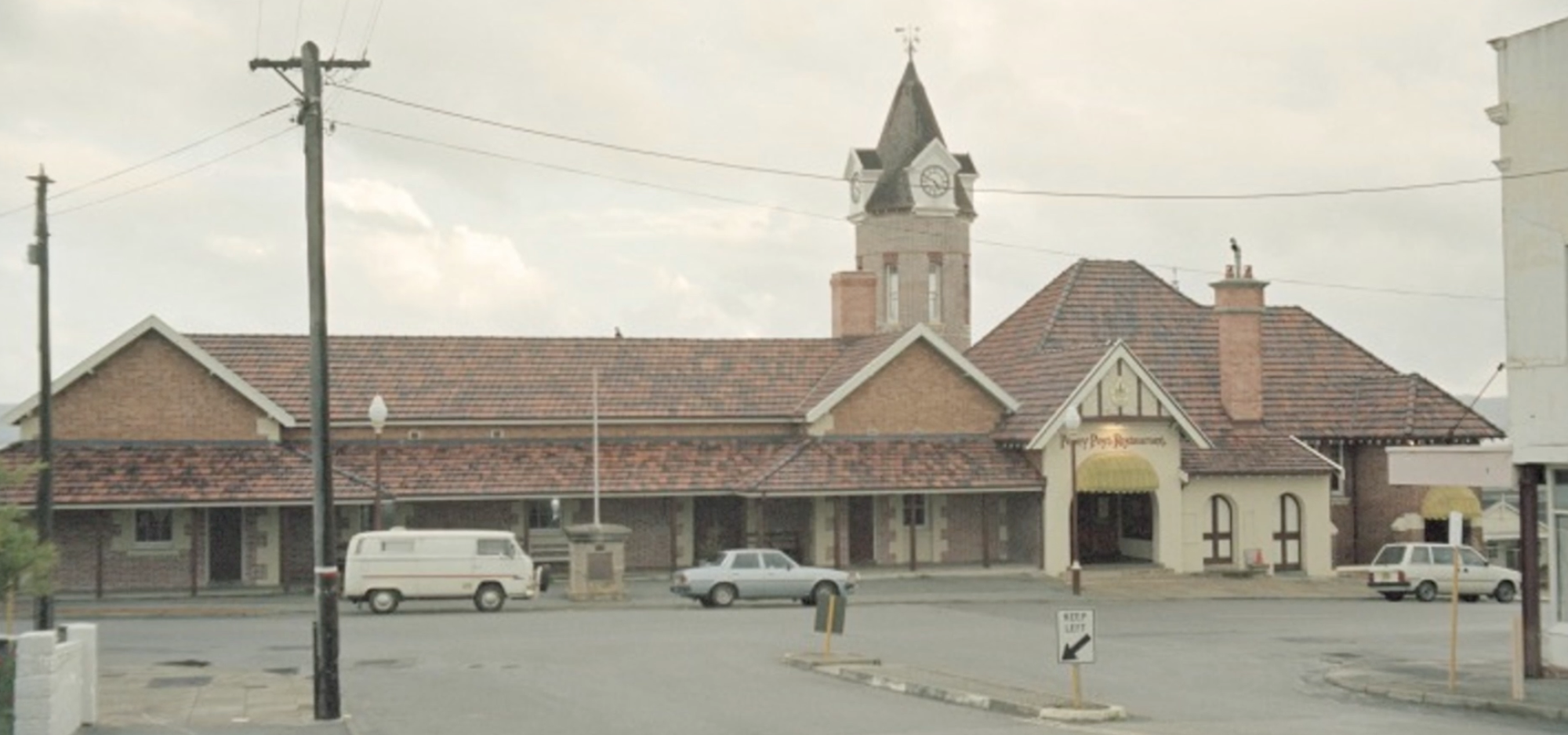
Albany Talks: Stirling Terrace Pavers
In this video Albany historian Malcolm Traill looks into the lives of those families and individuals commemorated in paving stones in one block of Stirling Terrace.
-
Episode transcript
Hello there. I'm Malcolm Traill. I work at the Museum of the Great Southern in Albany, Western Australia. I'm a historian, and this is another in the curatorial series of talks on Albany history. So welcome. Today I'd like to look into a bit of a mystery. I love history mysteries because this is a story of some paving stones in a street in Albany that have been in the footpath for nobody knows quite how long.
They're in paving stones with people's names on. And people in Albany have probably walked over this area so many times without even really noticing them and not knowing what they're commemorating, who put them there, and even when. So let's begin. So where are these stones? Well, they're in a street in Albany called Stirling Terrace. Stirling Terrace is one of the oldest streets in Western Australia.
It's one of the first streets in Albany which was settled by Europeans first in 1827, two and a half years before Perth. And this street is one of the original streets from the first town plans of the 1820s.
It runs parallel to the waterfront, and as Albany was a port, it was really the main street of Albany. It contained the businesses, the banks, the department stores, the post office, the hotels and boarding houses as well.
So it has a long history. And if you visit there today, which I hope you will be able to do at some point, you'll see that it is one of the best examples of the Victorian streetscape anywhere in Australia. It's just about untouched from the 1890s.
Some of these photos that I'm showing you now show Stirling Terrace from the 1980s, when it was a far different street to what it is in 2020s.
Nowadays it's been revived. It contains coffee shops, cafes, restaurants, antique stores, clothing stores and revived hotels. Hotels that are far different from those from the 1980s and even further back than that. So it's a street that had a revival. These photos from the 1980s show a street that's quite rundown, that's quite decrepit, that's unpopulated. Not a place where people would go to.
Today, it's far different as I said, and the street, although it runs for a number of blocks. The street that I'm talking about today is really only one block long, because this is where these pavers have actually been put.
And they commemorate individuals, families, businesses that all have some connection with this bit of Stirling Terrace that I mentioned in Albany. We call it the Terrace. It is just the Terrace. So let's make a start at the eastern end of the Terrace, just near the corner of Spencer Street by the old Post Office building. And this first plaque commemorates the Everett family.
The Everett's ran an emporium, a merchant store on the corner of the Terrace and Spencer Street, and it was a grand store. It was one of three emporiums or department stores that existed on the Terrace during the late 19th and for the first half of the 20th century. You can see in the picture of Everetts and the general merchant store that it was a two-storey building with wrought iron.
And the advertisement on the screen now gives you some indication of ‘Everett Store opposite the post office’. So the highest quality groceries and the finest British chinaware and glassware. And this whole photo with the staff at the front shows the draper, grocer and direct importer of Everett Store. And the date on there, I think is 1908. And there were also ironmongers and produce merchants.
So who were the Everett family? The original Mr. Everett was Edward Everett. Edward Gamble Everett, to give him his full name, and he came here from South Australia in 1897.
He established himself first on Stirling Terrace, and from the Cyclopedia of Western Australia of 1912, it says that he decided to settle at Albany, and at once opened up business as a general grocer and draper, and by dint of energy and strict adherence to sound commercial principles, he laid the foundation of the prosperous concern, which has weathered all storms and is now one of the most thriving business houses in the picturesque little seaport, and would ever since taking up his residence in Albany, has given what time he could spare to furthering the interests of the place.
And he's been a member of the Albany Chamber of Commerce, also the committee men of the Agricultural and Horticultural Society. And he also had two sons and a daughter, who also became connected with the business, and one of whom, we have a picture of Eric Samuel Everett.
Who became quite prominent. And he's mentioned that he gives a fair amount of his leisure time to athletics and enjoys participation in most forms of sport, particularly in football, tennis and swimming, and was a commissioned officer in the Cadet Force forces, also being a marksman of some merit. Now, this is interesting because Eric Samuel Everett actually enlisted in the forces and in World War Two became a major in the Home Defence Forces at quite an advanced age, like 40s, early 50s, and was quite prominent in Perth business circles.
The Everett business has actually diversified, and in the late 19th century they actually bought a shipwreck, the Dunster Castle, which had been wrecked near Esperance of the southern coast of Western Australia. And they employed members of the Douglas family, who are well known maritime salvage agents and pilots, to actually salvage as much as they could from the Dunster Castle which the Everetts had bought.
This exercise went on for about two years with very little profit, and I'm sure was very frustrating for the Douglas family, but not much came of their efforts into diversifying into shipwreck salvage.
That's the Everett family. That corner, by the way, is known as Everett's Corner. And that's what the plaque on the footpath says. Some of these plaques are quite easy to read. Some have been refurbished. And that's one of these mysteries as to where these plaques came from and when.
General common knowledge in Albany seems to point to about the 1970s that they were put in the footpath, and that they were paid for by members of the families which they commemorate. And that I found out from the grandson of this plaque here, Thomas and Gertrude Knight. The Knight family didn't have any particular connection to Stirling Terrace.
As I mentioned, but they were a hardworking Albany family who became farmers and came here in the 1880s from a place called Sofala in New South Wales. Now, Sofala has a gold mining history. It's one of the first places where gold was found in Australia, anywhere in Australia in the 1850s. It's a little town near Bathurst in central New South Wales, and the Knights have come here from Sofala now.
Sofala, I found, is quite well known, from this painting by noted Australian artist Russell Drysdale. He painted Sofala in 1947. The main street. If you look at the main street, it's Sofala today, which is a tiny little village. Nothing much has changed from that painting by Russell Drysdale. What do we know about the Knight family?
Well, they first went to the goldfields in Western Australia to try and continue their gold seeking activities. But like so many, they didn't have much success in Kalgoorlie and decided to come south to the south coast, where they bought land at a place called Robinson Estate in Gledhow, just outside Albany on the railway line. They became small farmers and vegetable growers.
Their descendent Tom Knight was a prominent Member of Parliament for Albany in Western Australia in the West Australian Parliament in the 1970s and 80s and the 90s, and his wife became even more prominent, as the Mayor of Albany. His wife's name was Annette Knight, and she died a little while ago. She was the Mayor of Albany for several years, and became one of the greatest advocates for Albany on the state and national stage.
So that's recapping the history of the Knights and their plaque in Stirling Terrace in Albany. Our next plaque moving westwards, celebrates George James Hill. You can see from the dates that he was a councillor and died in 1928. Now who is George James Hill? Here's a picture of him. A grand, stern looking man with a strong moustache.
He was a butcher as well as being a town councillor, but ironically, his butcher's shop was not on the Terrace. It was on York Street. Here's a picture in the early 1900s of George Hill and Company, Butchers, just next to the baker's shop. George Hill started this shop with his son, and there's one of his wagons loaded up outside.
This is a carefully posed photo, obviously, but if you look more closely at the photo and enlarge it, you can actually see inside the portico of the shop, and you can actually see those sides of beef hanging outside on the footpath. I doubt that he'd get away with that today. George Hill became a prominent councillor, and I'm assuming that his family paid for this plaque on Stirling Terrace to commemorate him, because one of his sons, Len Hill, became a Kalgan River orchardist and a prominent member of the Country Party in Western Australia.
He represented Albany in the state parliament for many years. I think he still holds the record for the number of years of any Albany politician for service in state parliament.
Len Hill's granddaughter is a prominent horsewoman in the region. Her name is Sonja Johnson, and Sonja won a silver medal for Australia in equestrian events at the Beijing Olympics in 2008. On her horse Ringwould Jaguar. So the full line goes down from George Hill, the butcher, to Sonja Johnson, the horsewoman. Let's move along the footpath.
This one is very hard to read from the photograph. A little easier in real life because it's been gilded and upgraded. But it says, and I'll read it out. “Doctor A.R. Home E.D., Port Medical Officer,” and it gives the dates there. So who is Doctor Home? Well, Doctor Home was a well-loved GP in Albany from the period before the Second World War and after the war as well.
Here's a picture of him as a member of Albany Council with his fellow doctor who was the Mayor. Doctor Harry Hanrahan. Now Doctor Home and Doctor Hanrahan, both general practice practitioners in Albany, both prominent medical people. Doctor Home gained some notoriety and fame during World War Two. And when you look at these next pictures, you can see a picture of him in military uniform as a military doctor in the Army, and also some decorations that he received for his service to the St John Ambulance Service.
Doctor Home was a doctor in Singapore during the early days of World War Two, and he was captured by the Japanese and held prisoner in Changi Prison right through to the end of the war to 1945. I think he had a reputation as something like Weary Dunlop, although of course, he wasn't on the Burma Railway. Doctor Home maintained the health and morale of many of those prisoners who were held in Changi Prison for that long period, from 1942 through to 1945.
His health suffered, and he was most concerned about some of his nurses who were captured by the Japanese and later massacred on Banka Island, which is just off Indonesia. Doctor Home's health suffered greatly from his period as a prisoner of war. He did return to Albany and in fact practiced as a general practitioner and medical officer at the Albany Hospital, as well as the Port Medical Officer.
His wife, Enid, who he married after the death of his first wife, became very prominent in Albany Enid Home was well-known as a community advocate for so many causes, including the St John Ambulance, which her husband had been so much a part of. Let's move on down Stirling Terrace. We're now about halfway down, and this is the fourth, I think, of seven plaques, to the Barnett family.
Who are the Barnett family, you ask? Well, the Barnett family on the plaque, it says E.C. - that's Edward – T.H. - that's Thomas, and L.S. Barnett - that's Len Barnett - Merchants 1888 to 1969. Now that's the length of period that their shop existed on the Terrace and plaque is outside where their shop was. This was a big department store started by Edward Barnett.
That was another one to come from South Australia via Perth. And he set up the Department store of Barnett and Co. So let me tell you a little bit about Barnett’s Department store. Edward was the founder of the store and the patriarch of the Barnett family. His brother Thomas was also a partner in the shop and it was a grand two-storey building in the Terrace that really was very prominent right in the middle of this block that we’re talking about.
It had the first lift installed in any building in Albany, a rickety appliance that shuddered its way up to the second floor, if you were brave enough to take it. They used a novel system of vacuum tubes for cashier duties around the store. And this was endlessly fascinating to young people to see these vacuum tubes shooting around the shop, carrying dockets and change.
You can see from the pictures that I'm showing you that they sold wine and spirits that were grocers. There were ironmongers. They had Manchester and clothing of all sorts, they were grand importers. They were drapers and clothiers, furniture merchants and shoe salesman. They had everything and a prominent position. The building is still there but is no longer Barnetts.
It's no longer a department store. But it's interesting that the family became prominent because Thomas Barnett’s son Len later took over the shop as manager.
Let me read some of the comments made about Len Barnett when he died. He was a prominent person in the community. An executive member of the Albany Chamber of Commerce Foundation, member of the Albany Rotary Club. His obituary reads, “Because he was not ostentatious in his community service, he was apt to be misjudged by people who knew him only superficially, but his close friends knew the essential kindness of the man.
He was apt to be blunt in his speech he did not suffer fools gladly, but he had a rich sense of dry humor. His passing will leave a gap in Albany which will not be filled readily.” That was Len Barnett, who died in 1950. But Len’s sons were prominent in Australian history as well. His eldest son, Harvey, became one of the early heads of the Australian spy agency ASIO.
And his younger son Peter worked for the ABC as a foreign correspondent for many years from Washington, and was also the head of Radio Australia. So the Barnett legacy is a strong one in Albany. Moving along to the Muir family. And the Muir family also didn't have a presence on the Terrace like some of those earlier. I mentioned Robert Muir was the Mayor of Albany.
The Muirs were some of the earliest European settlers in Albany. They came out in the 1840s.
And here's a picture of Robert and Mary Muir. They were very prominent in the early days as farmers, but not Robert. Robert, due to a slight disability, was destined to become the manager of the Muir store in Albany, which marketed and processed much of the produce that was produced by the Muir Farms, which stretched all the way from Manjimup to Albany.
Robert Muir became a prominent citizen in Albany and was Mayor of Albany when the town hall clock was installed in 1891. He was the one who started the Albany Town Hall clock. His family lives on. There's many descendants of Muirs in Albany still, and in the region. One of his direct descendants was the fashion designer Liz Davenport, who was, a daughter of one of the Muir children. So the Muir family are commemorated - not just Robert Muir, but the whole family by their plaque in Stirling Terrace.
A couple to go. Let's have a look at Pearl Photos. This is a business that is commemorated in the photos. Was literally on the Terrace near the corner of York Street for those people familiar with the Albany geography. It says there “Pearl Photos Established 1920. P & G Cole 43 years on the Terrace”. So Pearl Photos had been on the Terrace for 43 years.
Established in 1927, they didn't actually start their business on the Terrace, and when they started, they weren't a couple. It was Geoff Cole and Pearl Hartshorn. That's the P in Pearl Photos. They started a business around the corner on York Street, but quickly moved onto Stirling Terrace and set up a photographic business which promised ‘Quality first. Speed always.’
Photos of course were quite popular through Box Brownie cameras, but you needed your own processor. So this is where Pearl Photos came in. And they also did sporting photos, portrait photos, group photography, school groups, all of those sorts of services. And if you brought your order in before 10 a.m., you could have it ready by 5 p.m. the same day. They were legends on Stirling Terrace.
This picture of Geoff Cole in hat and jacket taking photos from the top of Mount Clarence over Albany Harbour is really quite evocative of the time. They hit notoriety in 1948 when they actually shared in the first prize of what was called the Charities Lottery, precursor of Lotto. Nine people were going to divide 3,000 pounds. And it was Pearl Cole who actually went and bought the ticket for that lottery win.
But undeterred by that win, they continued on their business on Stirling Terrace. And it was only with the death of Geoff Cole in 1973 that they decided that, that was enough. They were going to close their doors.
Geoff loved a chat. He was a very gregarious, outgoing guy, and anybody who cared to come into his shop, he'd be happy to share a yarn and a bit of news. It says in this obituary, though long past retiring age and in failing health, he continued in business because he loved talking to his old customers, many of whom he saw in photographs, from babies and prams to grandparents.
He'd been born in England and was in the Royal Navy for ten years. When he left the Navy, he settled in Western Australia, in Albany and was a keen businessman, raconteur and humorist. After the death of Geoff Cole, his wife Pearl didn't have the heart to continue and shut their doors in early 1974, but their business lives on in the plaque in the footpath on Stirling Terrace, just near the corner of York Street.
And this photo, which we'll conclude on, shows the little shop that they were in as part of that building on the corner of York Street and Stirling Terrace. There's a tiny little shop next door to a chemist.
It also served as headquarters for visiting optometrists in Albany. The thinking was if you couldn't see the photos, then perhaps you needed an optometrist as well.
So that's the story of those really interesting plaques along the Terrace, I think seven and all the mystery, or some of the mystery has been solved. They were put there by families sometime in the 1970s. Some have gone missing over the years as redevelopment and re-laying of footpaths has seen some taken up, not to be replaced.
But it's an interesting story and I love stories like that that give you a little microcosm of the town's history and all of those names, all of those people, all of those businesses played a strong part in the history of one of the oldest streets in Albany, and indeed of Western Australia. I hope you've enjoyed that little story of the footpaths and pavers of Stirling Terrace.
Thank you for listening.
More Episodes
Join Dr Tony Friend, Research Associate, DBCA to hear about the conservation story of Gilbert's potoroo.

Go behind the scenes of Albany Then & Now: Historical Panoramas of Menang Noongar Boodja exhibition.
In this video Albany historian Malcolm Traill looks at the influence of the Chinese in Albany and throughout Western Australia, from their first arrival in Sydney over 200 years ago to the present day.
In this video Albany historian Malcolm Traill discusses the history of quarantine in Albany.
In this video Albany historian Malcolm Traill discusses the hidden history of submarines in Albany.
In this video Albany historian Malcolm Traill explores some of the myths, legends, and ghost stories that have grown up around Albany over the last 200 years.
In this video Albany historian Malcolm Traill talks about a rivalry between two towns in Western Australia.

In this video Albany historian Malcolm Traill looks at the 1920s, a decade of heightened optimism in Albany after the trauma of World War One.
